Asked in Bengaluru (2026) — Fresher to Lead Level
Let’s be honest Bengaluru interviews are not what they used to be. Five years ago, you could walk into a mid-sized tech firm, answer a couple of basic OOP questions, write a bubble sort on a whiteboard, and land the job. Not anymore.
The city’s hiring bar has shifted dramatically. Product-first companies like Razorpay, Swiggy, Meesho, and CRED now run structured 4–6 round interviews that test everything from data structures to how you handle a production outage at 2am. Even startups that were hiring for ‘attitude over aptitude’ a few years back are now running system design rounds for engineers with just 3 years of experience.
So whether you’re a fresher walking in with your first resume from a Tier-2 college, or a Staff Engineer weighing an offer from a Whitefield MNC, the questions you’ll face in 2026 look very different from what Google returns on the first page. This guide covers 50 real interview questions across all experience levels with answers, context, and the kind of insider framing that actually helps you crack the round.
| 💡 TL;DR: This guide covers 50 software engineer interview Q&As across four levels Fresher (0–2 yrs), Mid-Level (3–7 yrs), Senior (8–12 yrs), and Lead (12–15 yrs). Each answer is written to help you understand, not just memorize. Browse the level that matches your experience, or read it all your call. |
What Makes Bengaluru Interviews Different From the Rest of India?
Mumbai has finance. Hyderabad has Microsoft and Amazon campuses. Pune has back-office tech. But Bengaluru specifically the belt running from Koramangala to Manyata to Whitefield is where India’s most competitive engineering interviews happen.
Here’s why that matters for your prep. Bengaluru companies hire across a wide band from ₹8 LPA freshers at IT services firms to ₹80 LPA+ Staff Engineers at product companies. That range means the interview style varies wildly too. A TCS or Wipro round looks nothing like a Flipkart or PhonePe round, even for the same job title. Knowing which type of company you’re interviewing at shapes what you study.
Product-based companies (CRED, Swiggy, Razorpay, Zepto) tend to go deep on DSA, system design, and behavioral rounds. IT services companies (Infosys, Cognizant, HCL) lean more on aptitude, communication, and basic technical knowledge. MNCs (Google, Amazon, Microsoft Bengaluru offices) run the most structured processes often 5–7 rounds with a written scorecard.
| Company Type | Key Interview Focus | Typical Rounds | Salary Range |
| Product Startup | DSA + System Design + Culture Fit | 4–5 | ₹20–80 LPA |
| IT Services (MNC) | Aptitude + Technical Basics + HR | 3–4 | ₹4–15 LPA |
| Global MNC (Google/Amazon) | DSA + System Design + Leadership Principles | 5–7 | ₹40–1.2 Cr+ |
| Mid-size Product Co. | DSA + Project Deep Dive + System Design | 4–5 | ₹15–50 LPA |
One more thing worth noting Bengaluru interviews in 2026 happen on platforms like HackerRank, CodeSignal, and CoderPad before you ever meet a human. Your first filter is algorithmic. So even if you’re a brilliant communicator with a stellar GitHub profile, if your LeetCode isn’t solid, you won’t get to the human rounds.
How to Use This Guide
These 50 questions are split across four experience bands. Jump to your level, or read all the way through senior folks reading the fresher section often find gaps they didn’t know they had.
| Level | Experience | Questions | Key Topics |
| 🟢 Fresher | 0–2 Years | Q1–Q15 | CS Fundamentals, OOP, DSA Basics, HR |
| 🟡 Mid-Level | 3–7 Years | Q16–Q30 | System Design, Databases, API, Behavioral |
| 🟣 Senior | 8–12 Years | Q31–Q42 | Distributed Systems, Architecture, Leadership |
| 🔴 Lead / Staff | 12–15 Years | Q43–Q50 | Org Design, Tech Strategy, Execution at Scale |
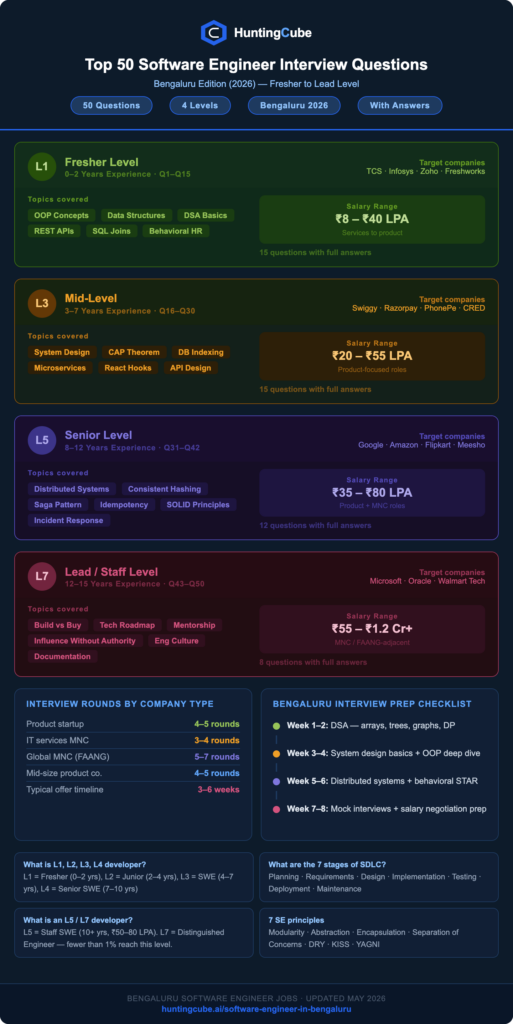
Part 1: Fresher Level (0–2 Years) Questions 1–15
First job interviews in Bengaluru have a reputation for being unpredictable. You might get a dead-simple OOP question, or you might get asked to implement a binary search tree on a shared Google Doc in real time. The good news? The range of topics is actually pretty finite. Master these 15, and you’ve covered 80% of what freshers face.
Core Computer Science & OOP – Fresher
A process is an independent program running in its own memory space. A thread is a smaller unit of execution that lives inside a process and shares its memory. Think of a process as a restaurant the thread is an individual waiter working inside it. Multiple threads (waiters) can serve different tables at the same time, but they all work within the same restaurant (process). In OS terms: processes are isolated, context-switching between them is expensive; threads share memory, which is faster but introduces risks like race conditions. Java, Python, and Go are commonly tested for threading concepts in Bengaluru product interviews.
The four pillars are Encapsulation, Abstraction, Inheritance, and Polymorphism. Encapsulation: bundling data and methods inside a class, restricting direct access (like a capsule medicine you take the pill, you don’t see the chemicals). Abstraction: hiding internal complexity and exposing only what’s necessary (like driving a car you use the steering wheel, you don’t know how the engine works). Inheritance: a child class inherits properties from a parent class (a Dog class inheriting from an Animal class). Polymorphism: the same method behaving differently based on context (a speak() method returning ‘Woof’ for Dog and ‘Meow’ for Cat). These are foundational every Bengaluru fresher interview will touch at least two of these.
Stack memory stores function calls and local variables it’s managed automatically and follows a Last In, First Out (LIFO) structure. It’s fast but limited in size. Heap memory is used for dynamic memory allocation (like creating objects with ‘new’ in Java or malloc in C). It’s larger, slower, and must be manually managed in some languages or handled by garbage collectors in Java/Python. Stack overflow? You’ve probably seen that error when a recursive function runs too deep. Heap issues usually show up as memory leaks in long-running applications.
Compile-time errors are caught before the program runs syntax mistakes, type mismatches, or missing imports. Your IDE highlights these before you even hit Run. Run-time errors occur while the program is executing like a NullPointerException in Java or dividing by zero in Python. They’re trickier because the code looks fine on paper but fails under specific conditions. In Bengaluru coding rounds, run-time bugs are what separate candidates who just write code from those who actually think through edge cases.
Access modifiers control the visibility of classes, methods, and variables. The main ones: public (accessible from anywhere), private (only within the same class), protected (same class + subclasses + same package), and default/package-private (same package only). Good OOP design means exposing only what needs to be exposed a principle called the Principle of Least Privilege. In interviews, they often ask you to fix a class design where private fields were made public unnecessarily. Knowing when to use which modifier shows you understand encapsulation beyond just textbook definitions.
Data Structures & Algorithms – Fresher
Iterative approach: Use three pointers prev (starts as null), current (starts at head), and next. For each node, store the next node, reverse the current node’s pointer to prev, then advance both prev and current. After the loop, prev becomes the new head. Time complexity: O(n). Space: O(1). Recursive approach is cleaner in code but uses O(n) stack space. In Bengaluru online assessments, the iterative version is preferred because it shows you understand pointer manipulation without relying on the call stack. Always mention edge cases: empty list, single node interviewers notice when you don’t.
Binary search runs in O(log n) time it works by halving the search space on each step. The key constraint: the array must be sorted. You can’t binary search a random list. The space complexity is O(1) for the iterative version, O(log n) for the recursive version (due to call stack). A common follow-up in interviews: ‘What if the array has duplicates?’ in that case, you need to decide whether to find the first occurrence, last occurrence, or any occurrence, and adjust your exit condition accordingly. LeetCode 704 is the classic version; 34 (find first and last position) is what Bengaluru mid-level assessments test.
BFS (Breadth-First Search) explores all nodes level by level using a queue it finds the shortest path in unweighted graphs. DFS (Depth-First Search) goes as deep as possible along one branch before backtracking, using a stack (or recursion). When to use which: Use BFS for shortest path problems (Dijkstra’s is an extension), for finding nodes closest to the source, or for level-order traversal of a tree. Use DFS for maze problems, detecting cycles, topological sorting, or when you need to explore all possibilities. A quick memory trick: BFS = Level order = Queue. DFS = Depth = Stack.
Arrays store elements in contiguous memory random access is O(1), but inserting or deleting in the middle is O(n) because you shift elements. Linked lists store elements in nodes with pointers insertion and deletion are O(1) if you have the pointer, but random access is O(n). Use arrays when you know the size upfront and need frequent random access (like pixel manipulation or matrix operations). Use linked lists when you need frequent insertions/deletions at arbitrary positions, or when the size is unpredictable. In practice, most modern codebases use dynamic arrays (ArrayList in Java, list in Python) which give you the best of both but the conceptual question still appears in almost every Bengaluru fresher round.
A hash table maps keys to values using a hash function that converts a key into an array index. Lookup, insertion, and deletion are O(1) on average which is why dictionaries in Python and HashMaps in Java are so commonly used. A collision happens when two different keys produce the same hash index. Two main ways to handle this: Chaining (each array slot holds a linked list of all key-value pairs that hash to that index) and Open Addressing (when a collision occurs, probe for the next available slot). In the worst case many collisions performance degrades to O(n). This is why good hash functions and load factor management matter.
Web & API Basics – Fresher
REST (Representational State Transfer) is an architectural style for building APIs that uses standard HTTP methods GET (read), POST (create), PUT/PATCH (update), DELETE (remove). Resources are identified by URLs. REST is stateless each request contains all the information needed; the server doesn’t remember previous requests. SOAP (Simple Object Access Protocol) is an older protocol that uses XML for messaging and has strict standards for security and transactions. REST is lightweight, widely adopted, and easier to work with for web and mobile apps. SOAP is still used in enterprise banking and government systems where strict contracts and security are non-negotiable. In Bengaluru fintech interviews (Razorpay, PayU, BillDesk), you’ll sometimes still see SOAP-related questions.
GET retrieves data parameters go in the URL, it’s idempotent (calling it multiple times has the same result), and responses can be cached. POST sends data to create or update a resource the payload is in the request body, it’s not idempotent, and responses are not cached by default. A quick rule of thumb: if you’re fetching something, use GET; if you’re submitting a form or creating a record, use POST. Interviewers often follow up with: ‘Can you send a body in a GET request?’ technically yes, but it’s not recommended and many servers ignore it.
SQL & Databases – Fresher
INNER JOIN returns only rows where there’s a match in both tables. LEFT JOIN returns all rows from the left table and matching rows from the right where there’s no match, the right side shows NULL. RIGHT JOIN is the mirror all rows from the right, matching from the left. A practical example: if you have a Users table and an Orders table, an INNER JOIN gives you users who have placed orders. A LEFT JOIN gives you all users, including those who haven’t ordered yet (those will have NULL for order details). This distinction matters a lot in analytics queries and is tested heavily in Bengaluru data-adjacent engineering interviews.
Normalization is the process of organizing a database to reduce data redundancy and improve data integrity. It happens in stages called Normal Forms (1NF, 2NF, 3NF and beyond). 1NF: each column holds atomic values, no repeating groups. 2NF: no partial dependency on a composite primary key. 3NF: no transitive dependencies (non-key columns should depend only on the primary key). Why it matters: an unnormalized database leads to update anomalies change a customer’s city in one place, forget to update it in another, and now your data is inconsistent. That said, for read-heavy systems, some denormalization is actually intentional for performance something to mention if you want to show depth.
Behavioral Fresher Round – Fresher
Structure this in 90 seconds: Current situation → relevant experience/projects → why this company. For freshers: your degree, the most impressive academic or personal project you’ve built, one specific skill you’ve focused on (say, backend development with Node.js), and why HuntingCube or the specific company you’re interviewing at. Avoid reading your resume out loud they have it. What they want to know is whether you can communicate clearly, prioritize the right information, and show genuine enthusiasm. A line like ‘I built a real-time notification system for my final year project and realized I wanted to work on systems that scale which is why I’m here’ is worth more than listing every course you took.
| 🎯 Fresher Tip: Most Bengaluru product companies run an online assessment (OA) on HackerRank or Unstop before the first human round. The OA typically has 2–3 coding problems (easy to medium difficulty) plus MCQs on OS, DBMS, and networking. Score in the top 20% of the OA cohort, and you’re almost guaranteed a first-round call. |
Part 2: Mid-Level (3–7 Years) Questions 16–30
Here’s where things get genuinely interesting. At the mid-level, companies aren’t just checking if you know how to code they want to know how you think under ambiguity. System design questions start appearing. Behavioral rounds carry real weight. And interviewers actively probe for depth, not just breadth.
The 3–7 year band in Bengaluru is also the most competitive. There are a lot of engineers at this level, and the salary gap between a ₹20 LPA offer and a ₹40 LPA offer often comes down to how well you articulate your design thinking. Let’s get into it.
System Design Getting Started – Mid-Level
Start by clarifying requirements: read-heavy or write-heavy? Do we need analytics? What’s the expected scale (millions of URLs, billions of redirects)? Core components: API layer (POST /shorten, GET /:shortcode), hashing strategy (Base62 encoding of an auto-increment ID or MD5 hash truncated to 7 chars), a relational or NoSQL store for the mapping (DynamoDB or PostgreSQL both work depending on scale), and a cache layer (Redis) for hot URLs since most redirects hit a small percentage of links. Handling collisions in hash-based approaches, expiry logic, and custom aliases are good follow-up points. At Bengaluru mid-level interviews, what separates a good answer from a great one is: did you start with requirements, and did you identify the bottleneck (reads) and address it with caching?
CAP theorem states that a distributed system can only guarantee two of three properties: Consistency (every read gets the most recent write), Availability (every request gets a response, even if it’s not the latest data), and Partition Tolerance (the system keeps working even if network partitions split nodes). Real-world: Cassandra and DynamoDB prioritize Availability + Partition Tolerance (AP) you get a response, but it might be slightly stale. Traditional RDBMS like MySQL prioritize Consistency + Availability (CA) but they struggle with partitions. In practice, network partitions are unavoidable in distributed systems, so you’re really choosing between C and A when a partition happens. This is one of the most commonly misunderstood concepts interviewers notice when you get it right.
An index is a data structure (usually a B-tree) that speeds up read queries by letting the database find rows without scanning the entire table. Think of it like a book’s table of contents. Without an index, a query like SELECT * FROM orders WHERE user_id = 12345 scans every row. With an index on user_id, it jumps directly to the right rows. When indexes hurt: write operations (INSERT, UPDATE, DELETE) become slower because the index must be updated too. Also, indexes consume disk space a heavily indexed table on a write-heavy workload (like a logging system) can create a performance bottleneck. A good mid-level answer mentions: choosing columns with high cardinality for indexing, and being cautious about indexing every column.
SQL databases (PostgreSQL, MySQL) are relational, schema-based, and ACID-compliant. Best for: complex queries, transactions, and structured data with clear relationships (e.g., e-commerce orders, financial records). NoSQL databases (MongoDB, Cassandra, DynamoDB, Redis) are schema-flexible, horizontally scalable, and optimized for specific access patterns. Best for: high-volume writes, unstructured or semi-structured data, real-time applications, and caching. The trick answer in interviews: neither is universally ‘better.’ Most production systems at Bengaluru product companies use both PostgreSQL for transactional data, Redis for caching, and something like Elasticsearch for search. Show that nuance and you’ll stand out.
Sharding splits a large database horizontally across multiple servers each shard holds a subset of the data. For example, users with IDs 1–1M go to Shard 1, 1M–2M to Shard 2, and so on. This allows the system to scale reads and writes beyond what a single server can handle. Problems sharding introduces: cross-shard queries become expensive (joining data across shards), resharding is painful when a shard becomes too large, and hotspots can occur if the shard key isn’t chosen well (all orders from a popular seller going to one shard, overloading it). Hotspot-aware sharding uses consistent hashing to distribute load more evenly. This is a standard system design follow-up at Meesho, Flipkart, and Myntra interviews.
Backend Development & APIs – Mid-Level
Synchronous code executes line by line each operation waits for the previous one to complete. Simple, predictable, but slow for I/O-heavy tasks. Asynchronous code allows other operations to proceed while waiting for slow tasks (like a database query or API call) to complete.
In Node.js, this is handled through the event loop with Promises and async/await.
In Java, you’d use CompletableFuture or reactive frameworks like Project Reactor.
In Python, asyncio.
The key benefit: async dramatically improves throughput in I/O-bound applications. The downside: debugging async code is harder, and ‘callback hell’ (before Promises) was a real problem. For most Bengaluru backend roles, understanding async patterns in your primary language is non-negotiable.
A monolith is a single deployable unit where all functionality lives together simpler to develop initially, easy to debug locally, but hard to scale specific parts and risky to deploy (one change affects everything). Microservices split functionality into independent services that communicate via APIs or message queues. Each service is independently deployable and scalable. But they add significant operational complexity: network latency between services, distributed tracing, managing multiple deployments, data consistency across services, and the overhead of service discovery. The honest answer: most companies start with a monolith and break it into microservices as specific bottlenecks emerge. At Bengaluru mid-level rounds, they’re testing whether you understand why microservices add complexity not just whether you’ve heard the buzzword.
Rate limiting restricts how many requests a client can make in a given time window protecting your service from abuse and ensuring fair usage. Common algorithms: Fixed Window (allow N requests per minute, reset at the start of each minute simple but allows bursting at window boundaries), Sliding Window (smoother, tracks requests over a rolling time period), Token Bucket (clients get tokens refilled at a steady rate; each request consumes a token allows short bursts), and Leaky Bucket (requests are processed at a constant rate regardless of input rate). Implementation: typically done at the API gateway (Kong, NGINX, AWS API Gateway) using Redis to store request counts per client ID. In interviews, mentioning the specific algorithm and why you’d choose it over others shows real-world experience.
In a monolith with a single database, transactions are straightforward ACID properties handle consistency. In microservices, each service owns its own database, so you can’t use a single database transaction across services. Two main patterns: 2-Phase Commit (2PC) a coordinator asks all services to prepare, then commit. It guarantees consistency but is slow and has a single point of failure. The Saga Pattern is more commonly used in production: each service performs its local transaction and publishes an event; subsequent services listen and react. If a step fails, compensating transactions roll back previous steps. Choreography (services emit events directly) vs Orchestration (a central orchestrator coordinates) are the two Saga variants. Bengaluru fintech interviews (Razorpay, PhonePe) test this heavily.
Frontend Mid-Level
The real DOM is slow to manipulate directly because any change can trigger reflow and repaint expensive browser operations. React maintains a virtual DOM: a lightweight in-memory representation of the actual DOM. When state changes, React re-renders the virtual DOM first, then diffs the new virtual DOM against the previous version (reconciliation), and applies only the minimal set of changes to the real DOM. This batching of updates is what makes React fast at scale. A common follow-up: ‘Is the virtual DOM always faster than direct DOM manipulation?’ the honest answer is no, for very simple apps it adds overhead. But for complex UIs with frequent updates, the batching wins.
useState manages local component state triggers a re-render when state changes. Common misuse: storing derived state (values you can compute from existing state) as separate state variables. useEffect handles side effects API calls, subscriptions, timers.
Common misuse: missing dependency arrays (causing infinite loops) or putting too much logic inside a single useEffect. useContext provides a way to pass data through the component tree without prop drilling useful for themes, auth state, or user preferences.
Common misuse: overusing Context for frequently-changing state, which causes unnecessary re-renders. At Bengaluru product company interviews, they’ll often show you a broken component and ask you to identify which hook is misused.
Behavioral Mid-Level
Use the STAR format Situation (context), Task (your responsibility), Action (what you specifically did), Result (measurable outcome). The key word is ‘specific’ interviewers are tired of vague answers like ‘I worked on a payment gateway project and improved performance.’ What they want: ‘I identified that our PostgreSQL queries were doing full table scans due to a missing composite index on (user_id, created_at). I added the index, rewrote two slow JOIN queries, and reduced p95 latency from 1.2 seconds to 180ms, which dropped cart abandonment by 14%.’ Numbers, specificity, and ownership those three things make a great behavioral answer in a Bengaluru product interview.
What they’re testing: Do you fold under authority, or do you have conviction backed by data? Neither extreme is good. The answer they want to hear: You raised your concern clearly, presented data or reasoning to support your position, listened to their perspective, and ultimately either reached a consensus or deferred respectfully once you understood their reasoning. What not to say: ‘I just followed whatever they said’ (shows no initiative) or ‘I pushed until I got my way’ (shows poor collaboration). A real example involving a technical decision like disagreeing on a caching strategy and proposing an A/B test to resolve it shows maturity and engineering judgment.
Be honest but forward-looking. ‘I’ve learned a lot at my current company, but I’m looking for a role where I can work closer to the product layer and see the direct impact of my engineering decisions’ is much better than ‘My manager is bad’ or ‘The pay is low.’ If compensation is genuinely the reason, it’s fine to mention it as one factor just don’t make it the only factor. Companies in Bengaluru are well aware that top engineers get multiple offers and move for growth, compensation, and interesting problems. What they’re really screening for: will you leave us in 6 months for another offer, and do you have a coherent career narrative?
For a mid-level engineer, the best answer anchors around depth of impact not just title progression. Something like: ‘I want to become someone who can own a significant technical system end-to-end from architecture decisions to production reliability and ideally start mentoring junior engineers along the way. I’m genuinely drawn to [company’s specific product area] and I’d like to grow within this domain.’ Avoid saying ‘I want to be a manager’ in the first breath if it’s a technical role it can signal that you see engineering as a stepping stone rather than a career. And definitely avoid ‘I’m not sure yet’ it reads as lack of direction.
| 💡 Mid-Level Salary Reality Check (Bengaluru, 2026): A Software Engineer with 3–5 years at a product company should be targeting ₹25–40 LPA. At 5–7 years with strong system design skills, ₹35–55 LPA is realistic. HuntingCube’s live listings show open roles at ₹35–50 LPA for Lead Software Engineers browse huntingcube.ai/software-engineer-in-bengaluru to see current openings. |
Part 3: Senior Level (8–12 Years) Questions 31–42
Senior engineer interviews in Bengaluru operate on a different register entirely. Nobody’s asking you to reverse a linked list. The assumption is that you can code. What they’re probing now is whether you can think at system level, make intelligent trade-offs, and bring clarity to ambiguous problems.
Honestly, the biggest shift at senior level is that the ‘right answer’ starts mattering less than the quality of your reasoning. Two senior engineers can design the same system completely differently and both be correct the interviewer is watching how you handle ambiguity, not just what architecture you propose.
Advanced System Design – Senior Level
Start with requirements: What types of notifications? Push (mobile), email, in-app, SMS? What’s the delivery guarantee at-most-once, at-least-once, exactly-once? Core components: Producer services generate notification events and publish to a message queue (Kafka is standard here it handles high throughput and allows replay). A consumer service reads from Kafka, determines delivery channel, and routes to: FCM/APNs for push, SendGrid/SES for email, Twilio for SMS. A notification preference service (backed by Redis for fast reads) determines if the user has opted out of specific notification types. For scale: fan-out on write (pre-compute notifications per user) vs fan-out on read (compute at request time) for 10M users, hybrid approaches are common. Delivery tracking, retry logic with exponential backoff, and idempotency keys round out a production-grade answer.
Multi-region means running your application in two or more geographic regions simultaneously. Two main patterns: Active-Active (both regions serve live traffic traffic is split by geography or load balancing, and both regions can handle full load) and Active-Passive (one region is primary, the other is standby less expensive but has failover time). The core challenge: data consistency across regions. Write operations need a source of truth options include single-region writes with async replication (risk: data lag), multi-master with conflict resolution (complex but high availability), or CRDTs for specific data types. DNS-level failover (Route 53 health checks) handles routing during regional outages. RTO (Recovery Time Objective) and RPO (Recovery Point Objective) are the business SLAs that drive your architecture choices always mention these in senior-level answers.
Layered approach: First, profile and find the bottleneck is it compute, database, network, or external dependencies? Database: add indexes, optimize slow queries (use EXPLAIN ANALYZE in PostgreSQL), move hot data to Redis, consider read replicas for read-heavy workloads. Application layer: avoid N+1 queries (use eager loading or DataLoader for GraphQL), use connection pooling (PgBouncer for Postgres), and batch requests where possible. Network: use a CDN for static assets, enable HTTP/2 for multiplexing, compress responses with gzip/brotli. External dependencies: add timeouts and circuit breakers (Hystrix/Resilience4j), cache external API responses. Architecture: move synchronous operations to async (return 202 Accepted, process in background). At senior level, interviewers want to see that you profile before you optimize ‘measure twice, cut once’ applies to performance work.
Eventual consistency means that given enough time and no new writes, all replicas of a piece of data will converge to the same value. It’s a trade-off for availability and partition tolerance. In a user-facing product, this creates real UX challenges a user updates their profile picture but sees the old one for a few seconds. Strategies to handle it: read-your-own-writes consistency (route a user’s reads to the same replica they just wrote to), version vectors to detect conflicts, optimistic UI updates (show the expected state immediately, roll back if the write fails), and meaningful loading states. The key insight at senior level: eventual consistency isn’t just a database concept it’s something your product design needs to account for.
This is a layered problem. At small scale, LIKE queries in PostgreSQL work but degrade fast. At medium scale, use PostgreSQL full-text search (tsvector). At large scale, Elasticsearch or Solr. Core Elasticsearch concepts to mention: inverted index (maps terms to documents), analyzers (tokenization, stemming, stopwords), relevance scoring (BM25 by default). Beyond basic text search: faceted filtering (brand, price range, rating), typo tolerance (fuzzy matching), autocomplete (edge n-gram tokenizer), and personalization (reranking results based on user behavior). Index strategy: keep a denormalized document per product with all searchable attributes, and sync from your primary database using a change data capture (CDC) pipeline. Bengaluru e-commerce companies (Flipkart, Myntra, Nykaa) test this at senior level.
Distributed Systems – Senior Level
Consistent hashing is a technique for distributing requests or data across a cluster of nodes in a way that minimizes redistribution when nodes are added or removed. Without it, adding a new server to a 10-node cluster means rehashing nearly all keys a massive disruption. With consistent hashing, only K/N keys need to move (where K is the number of keys and N is the number of nodes). How it works: nodes and keys are mapped onto a circular hash space (a ‘ring’). Each key is assigned to the nearest node clockwise on the ring. Adding a node only affects keys between the new node and its predecessor. Used by: DynamoDB, Cassandra, Redis Cluster, and most CDN edge routing systems. The virtual nodes concept (multiple hash positions per physical node) solves the uneven distribution problem.
The Saga pattern manages distributed transactions across multiple microservices by breaking them into a sequence of local transactions. Each service performs its transaction and publishes an event; if a step fails, compensating transactions undo previous steps. Choreography: services emit events and react to each other’s events directly no central coordinator. Pros: loosely coupled, no single point of failure. Cons: hard to track the overall transaction flow, harder to debug. Orchestration: a central orchestrator (often a dedicated service) tells each service what to do and when. Pros: easy to visualize and debug the flow. Cons: the orchestrator becomes a bottleneck and a single point of failure. In practice, Bengaluru fintech and food delivery companies tend to use orchestration for critical flows (payments, order fulfillment) and choreography for less critical, fire-and-forget events.
An idempotent API operation produces the same result whether called once or multiple times. GET is naturally idempotent. DELETE is idempotent (deleting a deleted resource returns 404, not an error). POST is not idempotent by default submitting a form twice creates two records. To make POST idempotent: use an idempotency key (a unique ID generated by the client, sent as a header). The server stores this key with the result; if the same key is received again, return the stored result instead of processing again. This is critical for payment APIs if a network timeout causes a retry, you don’t want to charge the user twice. Stripe, Razorpay, and PayU all implement idempotency keys. At senior level in Bengaluru, this question separates engineers who have built payment or transaction systems from those who haven’t.
Code Quality & Engineering Culture – Senior Level
Code review is not just about catching bugs it’s a knowledge transfer mechanism, a quality gate, and a cultural signal. A great PR: small and focused (ideally under 400 lines), with a clear description explaining why the change was made (not just what), test coverage that matches the change, and no formatting/linting issues that distract reviewers from actual logic. As a reviewer: check for correctness first, then maintainability, then performance. Give specific, actionable feedback (‘This loop runs O(n²) consider using a HashMap to bring it to O(n)’) rather than vague comments (‘This could be better’). What makes a bad PR: a 2,000-line change two days before a deadline, with no description, and a comment that just says ‘various fixes.’ Bengaluru tech leads will ask this to gauge your engineering maturity.
SOLID: Single Responsibility (a class should have one reason to change), Open/Closed (open for extension, closed for modification), Liskov Substitution (subclasses should be substitutable for parent classes), Interface Segregation (don’t force clients to implement interfaces they don’t use), Dependency Inversion (depend on abstractions, not concretions). Real violation: a UserService class that handles authentication, sends welcome emails, and updates the database three responsibilities, three reasons to change. Fix: split into AuthService, EmailService, and UserRepository. A Liskov violation example: a Square class extends Rectangle, but overriding setWidth() also changes height (breaking the width/height independence assumption of Rectangle). These come up constantly at Bengaluru senior interviews the fix matters as much as identifying the violation.
First not all technical debt is equal. Deliberate debt (taking a shortcut to hit a deadline, with a plan to fix it) is different from accidental debt (bad code written because of lack of knowledge). The problem is when deliberate debt becomes permanent because there’s always a higher-priority feature. Practical strategies: track debt explicitly in your task management system (Jira, Linear) rather than in a comment like ‘TODO: fix this later’; use the 20% rule reserve 20% of sprint capacity for debt reduction; prioritize debt that sits on the critical path of features you’re building next. The best senior engineers make a business case for debt reduction: ‘This authentication module’s complexity is causing 3–4 hours of debugging per sprint. Refactoring it will save us ~2 days per quarter.’ Numbers get prioritized.
Incident response: detect fast (monitoring + alerts Datadog, PagerDuty, Grafana), communicate early (update the status page and stakeholders even before you have a fix), mitigate before you fix (if a rollback stops the bleeding, do that first, then find the root cause), and document as you go. Postmortems: blameless by design the goal is to understand the system failure, not to assign fault. Five Whys is a common technique to find the root cause. Action items from the postmortem should be specific and assigned to someone (not just ‘improve monitoring’ rather, ‘Add an alert for p99 latency exceeding 2s on the payments API by Friday’). Companies like Swiggy, Zomato, and Amazon in Bengaluru run rigorous COE (Correction of Errors) processes knowing this process signals senior maturity.
Part 4: Lead / Staff Level (12–15 Years) Questions 43–50
At Staff and Lead level, the interview dynamic flips. You’re not being asked to solve a problem you’re being assessed on whether you can define what the right problems even are. The questions get more open-ended, more philosophical, and frankly more interesting.
What Bengaluru MNCs and product companies are looking for at this level: Can you operate with autonomy? Can you influence without authority? Can you make the right call when the data is incomplete? These questions reflect that.
Architecture & Technical Strategy – Lead
Build vs buy comes down to four factors: total cost of ownership (buying is cheaper upfront, building compounds over time), strategic differentiation (build when it’s core to your competitive advantage, buy when it’s a commodity), team expertise (you need to own what you build a hand-rolled observability stack requires people who can maintain it), and time-to-market (buying a tool and integrating it is almost always faster than building). A framework that works in practice: define the requirement clearly, evaluate 2–3 existing solutions seriously, estimate the cost of integration and long-term maintenance, then decide. The trap to avoid: ‘we can build a better version’ you usually can’t, accounting for the full operational burden. At Lead level, they want to see that your default isn’t to build, and that you think about team bandwidth, not just technical elegance.
Start with product context: what problem is this vertical solving, who is the user, and what does success look like in 6 and 18 months? From there, map the technical capabilities needed infrastructure, data models, APIs, integrations. Identify the unknowns and de-risk them first (spikes, proofs of concept). Sequence work to maximize learning velocity early and deliver customer value incrementally. A good technical roadmap distinguishes between foundational work (things that must be right early because they’re expensive to change later auth, data models, core APIs) and tactical work (things that can evolve). It also accounts for non-feature work: observability, security, performance baselines. At Lead level, the question is whether your roadmap connects technology decisions to business outcomes not just whether you can build things.
New technology introduces risk learning curve, operational complexity, potential incompatibilities. A structured evaluation: define the specific problem the technology solves (not ‘it’s interesting’ what pain does it address?), run a time-boxed proof of concept in a non-critical system, evaluate operational maturity (how good is the tooling, documentation, community support, and vendor stability?), and assess team readiness (can your team hire for this, and will they support it on call?). Introduce gradually start with one service, instrument it well, run it in parallel with the old approach before committing. The worst technology introductions happen when someone comes back from a conference excited and the team adopts something org-wide without validation. Mentioning a specific tool you’ve evaluated (Kafka vs Pulsar, Kubernetes vs ECS, Temporal vs custom workflow) grounds your answer.
People & Organizational Impact – Lead
The goal of mentorship is to make yourself unnecessary to build engineers who can solve problems you’d have to solve otherwise. Concrete practices: teach frameworks for thinking, not just answers (instead of ‘use Redis here,’ explain why caching solves this specific problem and when it doesn’t); give ownership progressively (assign a junior engineer a feature with clear requirements, then gradually reduce the spec detail as they demonstrate capability); do joint code reviews where you explain your thinking rather than just marking changes. The dependency trap: being the person everyone comes to with questions feels helpful but doesn’t scale. Encourage engineers to write up their own solutions first, then come for a review the act of writing clarifies thinking. At Lead level, your impact is measured by what your team produces, not just what you produce.
Influence without authority is a core Lead skill you’ll work with teams, partners, and sometimes external vendors who don’t report to you. Structure: identify the problem clearly, build your case with data (not just opinion), find allies who share your perspective, present options (not just ‘my way’), and make it easy for stakeholders to say yes. A strong example: you noticed that two teams were building duplicate authentication systems independently. You proposed a unified auth service, ran a working group with engineers from both teams, presented a cost analysis (duplicate maintenance, inconsistent security surface), and got both teams to adopt a shared library without having authority over either team’s roadmap. The ‘without formal authority’ framing tests whether you can navigate org complexity a critical skill at Bengaluru product companies where cross-functional alignment is a constant challenge.
First, diagnose before prescribing. Is the issue estimation (stories are consistently underestimated?), scope creep (requirements change mid-sprint?), dependencies (the team is blocked by other teams?), or capacity (someone is pulled into other work)? Talk to the team individually, not just in standups the real reasons rarely surface in a group setting. Common fixes: right-size stories to 1–3 day tasks max (big tasks hide complexity), build buffer into sprint capacity (80% capacity planning, not 100%), make dependencies visible in sprint planning, and hold a brief retrospective specifically on why commitments slipped. What not to do: add pressure without removing obstacles, or blame the team without fixing the system. Bengaluru interviewers at Lead level are testing whether you default to process changes or people management ideally, you do both.
The honest take: most engineers hate writing documentation because they see it as extra work after the ‘real’ work is done. The engineers who get it right treat documentation as a design tool, not a post-implementation task. Write Architecture Decision Records (ADRs) when making significant technology choices capture the context, the options considered, and why you chose what you did. This is invaluable 18 months later when someone asks ‘why are we using Kafka instead of RabbitMQ?’ Keep READMEs and runbooks current by making them part of the definition of done for every feature. Avoid documentation for documentation’s sake a dense 40-page technical spec that nobody reads is worse than a 1-page ADR that everyone references. The goal is lowering the bus factor: could a new engineer understand this system and make changes without needing to ask you?
A great engineering culture is one where people do their best work consistently not just when they’re motivated or when the deadline pressure is high. Specific markers: psychological safety (people raise risks and bad news early, without fear), clarity of ownership (everyone knows what they’re responsible for), a bias for action balanced with learning from failure, and genuine respect for craft code quality, system design, and user experience all matter. How to build it: model the behaviors you want (if you want people to write good tests, write good tests yourself), make rituals of the things that matter (blameless postmortems, thoughtful code reviews, strong ADRs), and protect the culture during high-growth phases when shortcuts become tempting. At HuntingCube, we see this come up at Lead and Staff level interviews consistently companies like Razorpay, Swiggy, and Amazon Bengaluru explicitly test for culture-building ability at this level.
Frequently Asked Questions
L1 through L4 are engineering levels used by product companies to define seniority and compensation bands. L1 is entry-level (0–2 years), typically freshers or recent graduates. L2 is a junior engineer (2–4 years) expected to work with some supervision. L3 is a full Software Engineer (4–7 years) working independently. L4 is Senior Software Engineer (7–10 years) expected to lead features and mentor others. These levels vary slightly by company: what Amazon calls L4 (SDE I) is different from what Google calls L4 (Software Engineer). In Bengaluru, most product companies have mapped their internal levels to these industry-standard bands.
L5 is Staff Software Engineer or equivalent typically 10+ years of experience, with a salary range of ₹50–80 LPA in Bengaluru. At Google, L5 is Senior SWE. At Amazon, it’s SDE III. L5 engineers own significant technical systems, drive technical direction for their team or area, and actively mentor engineers at L3 and L4. Getting to L5 is genuinely hard it requires not just strong execution but demonstrated impact across multiple teams or products.
L7 is Distinguished Engineer or Senior Principal Engineer a role that fewer than 1% of engineers ever reach. At Amazon, L7 is equivalent to Director of Engineering from a compensation standpoint. These engineers set technical direction at the organizational level, publish research or open-source tools that influence the industry, and often help shape company strategy. In Bengaluru, L7 roles are mostly at the large MNC offices of Google, Amazon, and Microsoft.
Several strong IT careers don’t need coding skills: Business Analyst, IT Project Manager, Scrum Master / Agile Coach, UX/UI Designer (tools-based), Technical Recruiter, IT Support, Network/Cloud Administrator, Pre-Sales Engineer, Data Analyst (Excel + SQL level), and Digital Marketing Manager. Many of these roles pay ₹10–30 LPA in Bengaluru with the right experience and certifications.
The Software Development Life Cycle has seven stages: Planning (define scope, feasibility, timelines), Requirements Analysis (what the system must do), System Design (how it will do it architecture, tech stack, data models), Implementation/Coding (the actual development), Testing & QA (unit, integration, UAT), Deployment (releasing to production), and Maintenance (monitoring, bug fixes, updates). In Agile environments, these stages overlap and repeat in short sprints. Most Bengaluru product companies run 2-week sprints with continuous deployment.
The seven widely referenced principles are: Modularity (independent, interchangeable components), Abstraction (hide complexity behind clean interfaces), Encapsulation (bundle data and behavior), Separation of Concerns (each module handles one responsibility), DRY (Don’t Repeat Yourself), KISS (Keep It Simple), and YAGNI (You Aren’t Gonna Need It). These underpin good system design and come up directly or indirectly in most senior-level Bengaluru interviews.
Software Engineer Salary Benchmarks Bengaluru 2026
These ranges reflect current HuntingCube listings and market data. The wide bands reflect the difference between IT services firms (lower end) and product-first companies like Razorpay, Swiggy, and CRED (higher end).
| Level | Experience | Role | Salary Range (LPA) | Company Type |
| L1–L2 | 0–2 Years | Software Engineer | ₹8 – ₹40 | Services to Product |
| L3 | 2–5 Years | Software Engineer / SDE II | ₹20 – ₹55 | Product-focused |
| L4 | 5–10 Years | Senior Software Engineer | ₹35 – ₹80 | Product + MNC |
| L5 | 10–12 Years | Staff / Lead Engineer | ₹55 – ₹1 Cr | Product + FAANG-adjacent |
| L6–L7 | 12–15+ Years | Principal / Distinguished | ₹80 Cr+ | MNC / FAANG |
Note: ESOPs can add significantly to total compensation at funded startups. When evaluating an offer, factor in the vesting schedule, cliff period, and the company’s funding stage.
Ready to Put Your Prep to Work?
Reading 50 interview questions is a start. But the real edge comes from seeing what companies are actually hiring for right now the specific tech stacks, salary ranges, and experience requirements that live job listings reveal.
HuntingCube lists verified Software Engineer openings across Bengaluru, updated daily. No recycled listings. No salary ambiguity. Real companies, honest numbers, and roles that match your level from fresher roles in Electronic City to Staff Engineer positions in Manyata Tech Park.
Browse open Software Engineer roles in Bengaluru → huntingcube.ai/software-engineer-in-bengaluru