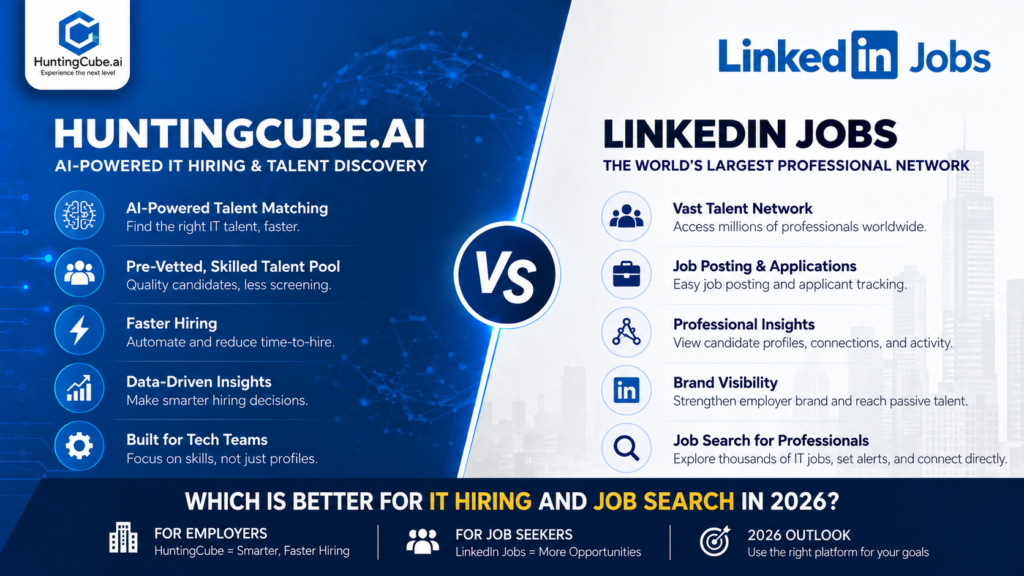
HuntingCube.ai and LinkedIn Jobs approach hiring from different starting points. LinkedIn combines job search with a professional network, recruiter tools and employer branding. HuntingCube combines CubicAI with human recruitment expertise for specialist and difficult-to-fill roles.
HuntingCube reports 98% CubicAI match accuracy, a 93% internally verified offer-to-acceptance ratio, and an 8-hour turnaround for relevant mandates.
If you need broad market visibility and networking, LinkedIn has the edge. If you need targeted sourcing for specialised technology roles, HuntingCube takes a more focused approach.
What Is HuntingCube.ai?
HuntingCube.ai is an AI-powered recruitment platform built by HuntingCube, a recruitment company founded in 2015.
HuntingCube has completed 5,000+ placements across 500+ organisations, supported by 300+ recruitment professionals and a 3M+ talent network.
The platform combines CubicAI with human recruitment expertise to help identify, evaluate and shortlist candidates for specialised hiring requirements.
CubicAI Matching Engine Explained
CubicAI is HuntingCube’s recruitment intelligence engine for candidate discovery and matching.
HuntingCube reports 98% match accuracy for CubicAI. This refers specifically to the platform’s matching capability and is separate from the company’s 93% offer-to-acceptance ratio.
The idea is straightforward: use AI to narrow down the relevant talent pool, then bring recruiter expertise into the process where context and judgement matter.
Who HuntingCube Is Built For
HuntingCube has a strong focus on specialised technology hiring, including HFT, Quant, AI/ML, GCC, semiconductor, deep tech, low-latency engineering and senior technology roles.
Its recruitment capabilities also extend into finance, risk, compliance, KYC/AML, HR, operations and business development.
The strongest use case is where a company needs a specific profile rather than simply a large number of applicants. The platform serves clients across India, Dubai, Singapore, and the UK.
What Is LinkedIn Jobs?
LinkedIn Jobs is the job discovery and hiring layer of LinkedIn’s professional network. Unlike a standalone job portal, it sits alongside professional profiles, networking, company pages and recruiter products.
LinkedIn has more than 1 billion members across 200+ countries and territories, giving employers and candidates access to an exceptionally broad professional audience.
LinkedIn’s Scale and Professional Network Model
LinkedIn’s biggest advantage is the ecosystem around its jobs platform.
A candidate can maintain a professional profile, follow companies, build connections, engage with industry content and search for jobs from the same account.
For recruiters, LinkedIn Recruiter adds advanced search, candidate recommendations, InMail, Boolean and keyword search, and more than 40 advanced filters.
That makes LinkedIn particularly useful when the objective is not just filling an open position but also building visibility and reaching people who may not be actively applying.
How LinkedIn Jobs Matching & Easy Apply Work
LinkedIn uses information such as a candidate’s profile, experience, skills, location and job preferences to personalise job recommendations.
Candidates can search using keywords and filters or use natural-language descriptions to find relevant roles.
For applications, some listings offer Easy Apply, allowing candidates to apply directly on LinkedIn. Others redirect candidates to the employer’s career site or another application system.
Easy Apply is therefore an application mechanism, not the same thing as LinkedIn’s candidate-matching technology.
HuntingCube vs LinkedIn — Core Feature Comparison
Job Matching Technology: AI-Based Matching (HuntingCube) vs Network/Keyword Visibility (LinkedIn)
The comparison is not simply AI versus keywords. LinkedIn itself now uses AI across job search and recruiting.
HuntingCube uses CubicAI to identify relevant candidates and combines the technology with human recruiter evaluation. HuntingCube reports a 98% CubicAI match accuracy.
LinkedIn uses profile information, job requirements, candidate preferences and recruiter search technology to surface relevant people and opportunities.
The bigger difference is what happens after the match. LinkedIn gives employers the tools to search and manage the process themselves. HuntingCube combines its matching technology with recruitment execution.
Talent Pool & Reach
This is where LinkedIn has an obvious advantage in scale.
With more than 1 billion members globally, LinkedIn gives employers access to a massive professional network.
HuntingCube’s 3M+ talent network is much smaller, but its recruitment focus is concentrated around technology and specialist hiring.
For a recruiter who wants maximum market reach, LinkedIn’s scale matters. For a narrowly defined mandate, the size of the database is only one part of the equation.
Shortlisting Speed
LinkedIn Recruiter allows recruiters to search, filter and contact candidates directly. Its AI-assisted capabilities can also help recruiters turn hiring requirements into candidate searches.
HuntingCube combines CubicAI sourcing with recruiter-led qualification. HuntingCube reports an 8-hour turnaround for relevant mandates.
Actual hiring speed still depends on the role, candidate availability, notice period and the employer’s interview and decision process.
Platform Focus (Niche IT vs All-Industry Networking)
LinkedIn covers virtually every major professional function and industry.
HuntingCube has a much stronger specialist orientation, particularly around HFT, Quant, AI/ML, GCC, semiconductor, fintech, deep tech and senior technology hiring.
That distinction matters when the role requires experience that is difficult to judge from a job title or a list of keywords alone.
Candidate Experience Comparison
Application-to-Shortlist Journey
LinkedIn gives candidates a familiar job-search journey. They can search, receive recommendations, apply through Easy Apply or continue to an employer’s application process.
HuntingCube’s experience is more recruiter-led. A candidate can be identified for a particular mandate and contacted directly when their profile matches what the employer is looking for.
That can be particularly relevant for experienced professionals who are not actively applying but may consider the right opportunity.
Visibility Without a Large Network
You do not need thousands of LinkedIn connections to apply for a job, but LinkedIn’s professional-network model does influence how candidates become discoverable.
A complete profile gives recruiters information about experience, skills, education and career history.
HuntingCube does not rely on a candidate building a large public network. The focus is more directly on whether the candidate fits a specific hiring requirement.
Job Alerts & Personalization
LinkedIn offers personalised job recommendations and alerts based on searches, profile information and preferences such as role, location and employment type.
HuntingCube’s matching is more closely tied to employer mandates and recruiter outreach.
For candidates who prefer browsing opportunities themselves, LinkedIn provides more control. For candidates who are open to being approached for relevant specialist roles, HuntingCube’s recruiter-led model can be useful.
Recruiter & Employer Experience Comparison
LinkedIn Recruiter/InMail Costs vs HuntingCube Pricing
LinkedIn offers several hiring products, including job postings, Recruiter and Recruiter Lite. Recruiter gives employers advanced search, recommendations, InMail and other sourcing capabilities.
Pricing varies depending on the product and commercial agreement.
HuntingCube follows a recruitment-led model supported by CubicAI, with its own employer engagement process.
The practical question for an employer is whether it wants recruitment software and access to a professional network, or wants AI-supported sourcing combined with recruitment expertise.
Time-to-Shortlist for Recruiters
LinkedIn gives recruiters direct access to profiles and lets them manage sourcing, outreach and candidate progression through its recruiter tools.
HuntingCube uses CubicAI to identify candidates and its recruitment team to qualify them against the mandate.
For recruiters managing large volumes internally, LinkedIn’s workflow can be useful. For teams that want more of the sourcing and qualification workload handled externally, HuntingCube offers a different approach.
Candidate Quality & Relevance for Niche IT Roles
LinkedIn can surface highly relevant technology professionals, particularly when recruiters know exactly what skills, experience and keywords to search for.
But niche hiring can become difficult when the requirement is more specific.
A company hiring a Quant Researcher, low-latency C++ engineer or semiconductor specialist may need to assess domain exposure, technical depth, career trajectory and practical experience, not just whether the right keywords appear on a profile.
That is where HuntingCube’s combination of CubicAI and specialist recruiters is designed to add value.
Match Accuracy — How Each Platform Surfaces Candidates
HuntingCube’s 98% Match Accuracy Claim
HuntingCube reports 98% CubicAI match accuracy.
The figure relates to CubicAI’s candidate matching and should not be confused with HuntingCube’s separate 93% internally verified offer-to-acceptance ratio, which measures a recruitment outcome.
LinkedIn’s Algorithm-Based Visibility Model
LinkedIn does not publish a directly comparable overall candidate-matching percentage.
Instead, its job matching uses information from candidate profiles and job requirements to identify relevant opportunities. LinkedIn Recruiter also uses AI-assisted search and candidate recommendations to help recruiters identify potential matches.
The two platforms therefore publish different types of information. HuntingCube reports a match metric, while LinkedIn provides information about how its matching and search capabilities work.
Pricing Comparison
Free vs Paid Tiers for Job Seekers
LinkedIn offers a free Basic account for job search and networking, alongside paid Premium plans with additional features.
HuntingCube does not charge candidates to be considered for employer mandates. Employers can begin with a complimentary pilot — either 3 human-reviewed profiles or 10 AI-curated profiles — at zero cost and zero commitment, to assess quality before engaging the full service model.
LinkedIn Recruiter/Premium vs HuntingCube Employer Plans
| Feature | HuntingCube.ai | |
|---|---|---|
| Talent access | 3M+ network | 1B+ global members |
| AI | CubicAI | AI-assisted search and matching |
| Employer model | AI + recruitment team | Self-serve + Recruiter |
| Candidate outreach | Recruiter-led | InMail |
| Advanced search | CubicAI-supported | 40+ Recruiter filters |
| Matching | 98% reported CubicAI match accuracy | No comparable public percentage |
| Offer acceptance | 93% internally verified | No comparable metric |
| Best suited for | Specialist hiring | Broad sourcing and networking |
LinkedIn Recruiter pricing varies by product and commercial agreement, so there is no single universal price to compare.
Which Platform Should You Choose?
Best For IT Job Seekers Without a Strong Network
LinkedIn remains useful even if you have a small network. Candidates can search directly, receive recommendations and apply to jobs without needing to build a large audience first.
HuntingCube offers another route: being considered for relevant recruiter-led mandates without relying on a large public network.
Best For Startups & Tech Recruiters on a Budget
LinkedIn gives startups access to a very large talent market and a range of free and paid hiring tools.
For companies with an internal recruiter who wants to manage sourcing, outreach and screening, LinkedIn can be a practical choice.
HuntingCube becomes more relevant when the company wants specialist sourcing and recruitment support rather than managing the entire search internally.
Best For Employer Branding & Passive Candidate Sourcing
LinkedIn has a clear advantage in employer branding.
Companies can publish content, showcase their culture, build followers, advertise roles and engage with potential candidates within the same professional network.
Its Recruiter and InMail capabilities also make it useful for reaching passive candidates.
HuntingCube’s strength is narrower: finding and engaging relevant talent for specific hiring mandates.
Real User Feedback & Trust Signals
Reviews and Reputation Snapshot
LinkedIn’s strongest trust signal is its scale and established position in professional networking and recruitment.
HuntingCube’s trust signals come primarily from its recruitment track record, client relationships and reported hiring outcomes.
For an employer, however, platform reputation should not be the only consideration. The relevant question is whether the platform can consistently address the type of role being hired.
Client/Employer Base Comparison
LinkedIn operates across industries and markets worldwide, with more than 1 billion members.
HuntingCube has completed 5,000+ placements across 500+ organisations and works across specialist hiring markets, with clients including DE Shaw, PhonePe, Meesho, Barclays, and KPMG.
LinkedIn offers much broader market reach. HuntingCube’s differentiation lies in its specialist recruitment focus.
HuntingCube vs LinkedIn Jobs — Comparison Table
| Feature | HuntingCube.ai | LinkedIn Jobs |
|---|---|---|
| Platform type | AI recruitment + human recruiters | Professional network + job platform |
| Founded | 2015 | 2003 |
| Talent reach | 3M+ talent network | 1B+ global members |
| AI | CubicAI | AI-assisted search and matching |
| Match metric | 98% reported CubicAI match accuracy | No comparable public percentage |
| Offer acceptance | 93% internally verified | No comparable metric |
| Applications | Recruiter-led mandates | Easy Apply + external applications |
| Recruiter search | AI + recruiter sourcing | Recruiter + advanced filters |
| Passive candidates | Recruiter-led sourcing | Network + InMail |
| HFT/Quant | Strong specialist focus | Supported through broad search |
| GCC | Specialist focus | Supported |
| Employer branding | Recruitment-led | Strong network advantage |
| Best for | Niche and difficult IT hiring | Broad reach and networking |
FAQs
What is HuntingCube.ai and how is it different from LinkedIn Jobs?
HuntingCube combines CubicAI with human recruitment expertise to identify and qualify candidates for specialised hiring mandates. LinkedIn Jobs combines job listings with professional networking and recruiter tools.
Is HuntingCube.ai a good alternative to LinkedIn for IT job hunting?
It can be, particularly for professionals interested in specialist or senior technology opportunities. LinkedIn is better suited to broad job discovery, networking and direct applications.
Does HuntingCube only cater to IT/tech job seekers, unlike LinkedIn?
No. HuntingCube has a strong technology focus but also works across functions such as finance, risk, compliance, HR, operations and business development.
How does HuntingCube’s AI matching work compared to LinkedIn’s Easy Apply?
CubicAI is HuntingCube’s matching engine. Easy Apply is LinkedIn’s application feature, allowing candidates to submit applications directly through LinkedIn. LinkedIn separately uses profile and job information to personalise job recommendations and matching.
Is LinkedIn Jobs still the best option for tech job seekers in 2026?
LinkedIn remains one of the strongest platforms for broad technology job discovery because it combines job listings with professional networking, personalised recommendations and recruiter visibility.
How fast does HuntingCube shortlist candidates versus LinkedIn Recruiter?
HuntingCube reports an 8-hour turnaround for relevant mandates. LinkedIn Recruiter gives recruiters immediate access to search and outreach tools. Neither represents a guaranteed hiring timeline because the final process depends on the role and employer.
What is HuntingCube’s CubicAI engine?
CubicAI is HuntingCube’s recruitment intelligence engine for candidate discovery and matching. It works alongside human recruiters to evaluate candidates against specific hiring requirements.
Is HuntingCube.ai free for job seekers like LinkedIn’s basic tier?
Candidates do not pay HuntingCube to be considered for employer mandates. LinkedIn also offers a free Basic account for job search and networking.
Is LinkedIn Recruiter worth the cost compared to AI-matching platforms?
It can be valuable for companies that need broad talent access, advanced search, passive candidate sourcing and direct outreach. HuntingCube is more relevant when specialist recruitment support is part of the requirement.
Which platform has better reach for niche IT roles, HuntingCube or LinkedIn?
LinkedIn has significantly greater overall reach. HuntingCube has a smaller 3M+ talent network focused strongly on technology and specialist hiring.
Can recruiters post IT jobs on both HuntingCube and LinkedIn?
Yes. LinkedIn supports job posting and Recruiter-based sourcing. HuntingCube works with employers through its AI-supported recruitment model.
Is HuntingCube suitable for candidates with a small LinkedIn network?
Yes. HuntingCube’s recruiter-led approach does not depend on a candidate having a large professional network or audience.
How does HuntingCube’s 98% match accuracy claim compare to LinkedIn’s algorithm?
HuntingCube reports 98% CubicAI match accuracy. LinkedIn does not publish a directly comparable overall matching percentage, so the two figures should not be treated as equivalent benchmarks.
What are the pricing differences between LinkedIn Recruiter and HuntingCube for employers?
LinkedIn Recruiter pricing varies according to the product and commercial agreement. HuntingCube’s employer pricing depends on the recruitment engagement. Employers should confirm current commercial terms directly with each provider.
Does HuntingCube offer an ATS or resume tool like LinkedIn’s profile system?
HuntingCube provides recruitment workflow and candidate management through its platform. LinkedIn provides professional profiles, job applications and Recruiter tools, with integrations available for hiring workflows.
Is HuntingCube.ai a startup, and how does it compare to LinkedIn?
HuntingCube.ai is the technology platform built by HuntingCube, a recruitment company founded in 2015. LinkedIn was founded in 2003 and operates at a much larger global scale.
Which platform is better for niche or highly specialised IT roles?
HuntingCube has a stronger specialist recruitment focus across areas such as HFT, Quant, AI/ML, GCC, semiconductor and other difficult technology mandates.
Do recruiters get more relevant candidates from HuntingCube or LinkedIn Jobs?
There is no independent apples-to-apples benchmark proving that one platform always produces more relevant candidates. HuntingCube combines CubicAI with recruiter validation, while LinkedIn provides large-scale search and professional-network data.
Can I use both HuntingCube and LinkedIn together for my job search?
Yes. LinkedIn can be used for job discovery, networking and applications, while HuntingCube can provide access to recruiter-led opportunities for specialist roles.
What do users say about HuntingCube.ai’s shortlisting turnaround time versus LinkedIn?
HuntingCube reports an 8-hour turnaround for relevant mandates. LinkedIn provides recruiters with immediate search and outreach capabilities, but the time to shortlist depends on the recruiter, role and hiring process.
Final Verdict — HuntingCube or LinkedIn Jobs?
LinkedIn is hard to beat when you want to put a role in front of a huge professional audience. It gives candidates jobs, networking and recruiter visibility in one place, while employers can search profiles, reach passive talent and build their employer brand at the same time.
HuntingCube takes a narrower route. Instead of asking recruiters to search through a massive professional network, it uses CubicAI to identify relevant talent and pairs that technology with recruitment expertise. That becomes particularly useful when the requirement is highly specific, such as a Quant Researcher, low-latency C++ engineer, semiconductor specialist or senior AI leader.
So the better question is not “Which platform is better?” It is “Where is the hiring bottleneck?”
If the challenge is getting enough visibility and access to the market, LinkedIn has the advantage.
If the challenge is finding the few people who actually fit a difficult requirement, HuntingCube is built around that problem.
For many hiring teams, the two can even serve different purposes: LinkedIn can create market visibility, while HuntingCube can step in when a role needs a more targeted search.
HuntingCube handles niche and senior IT hiring across India, Dubai, Singapore, and the UK. If the role you need to fill is not one a database search will reach, talk to the team at huntingcube.ai.