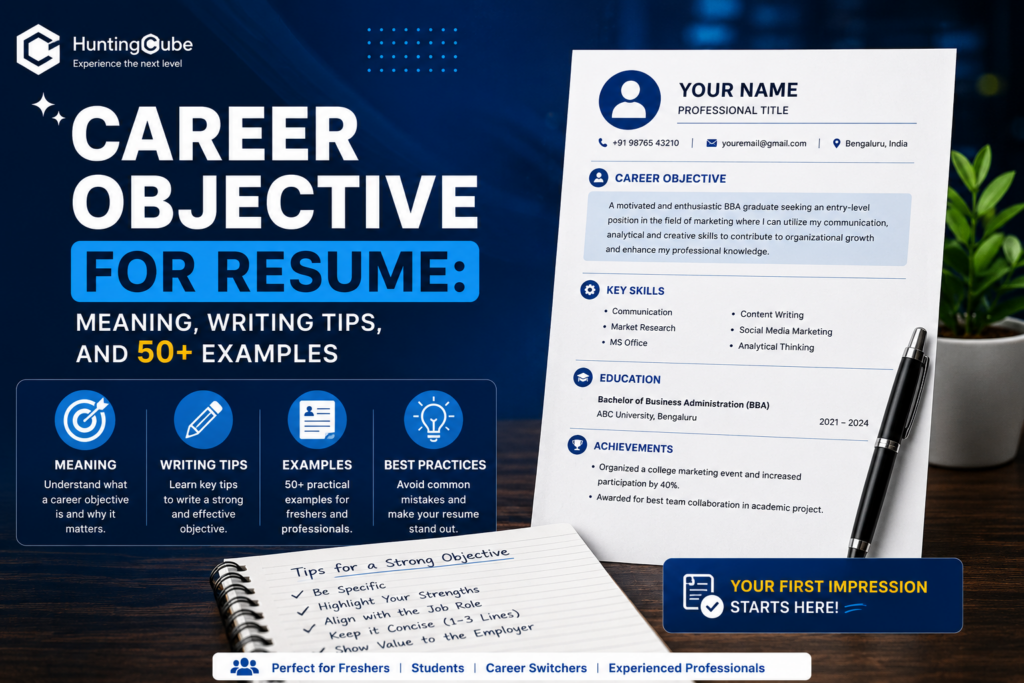
Your resume gets 6–10 seconds but your career objective for resume decides if it gets 60.
A career objective is a short opening statement that tells the recruiter who you are, what you bring, and what kind of role you’re looking for. It may look like a small section, but it often creates the first impression before your education, skills, or experience are even read.
In this guide, we’ll cover the resume objective meaning, how to write one, common mistakes, and practical examples you can actually use.
What Is a Career Objective in a Resume?
A career objective is a short statement at the top of a resume that highlights your goals, skills, and the role you are applying for.
The career objective meaning is simple: it introduces your professional direction in 1–3 clear sentences. It tells the recruiter what you want to do and how you can contribute to the company. For freshers, a resume objective statement is especially useful because they may not have years of experience to show. So instead of achievements, they highlight education, skills, interest, and potential.
For example, a fresher applying for an HR role can mention communication skills, people management interest, and willingness to learn. A software fresher can mention programming skills, projects, and problem-solving ability. A good objective is not about sounding fancy. It is about sounding clear.
Why Is a Career Objective Important?
The importance of a career objective is that it helps recruiters understand your fit quickly. Most recruiters don’t read resumes line by line at first. They scan. And in that quick scan, your objective can show whether your profile matches the job.
A strong career objective:
- Grabs recruiter attention early
- Shows your career direction
- Highlights your strongest skills
- Connects your profile with the job role
- Improves shortlisting chances
This matters more for freshers, students, career switchers, and people with limited experience. When your resume doesn’t have a long work history, your objective becomes your opening pitch. Think of it like the first line of a movie trailer. It should make the recruiter want to continue.
Career Objective vs Resume Summary
Many people confuse a career objective with a resume summary. Both appear at the top of a resume, but they serve different purposes.
| Career Objective | Resume Summary |
|---|---|
| Future-focused | Past-focused |
| Best for freshers, students, and career switchers | Best for experienced professionals |
| Highlights goals, skills, and role interest | Highlights achievements, experience, and results |
| Usually 1–3 sentences | Usually 2–4 sentences |
| Shows potential | Shows proven track record |
A resume objective says, “Here is what I want to do and how I can contribute.”
A resume summary says, “Here is what I have already done.”
For freshers, a career objective usually works better. For experienced professionals, a resume summary is often stronger. But even experienced candidates can use an objective when switching industries or applying for a new type of role.
How to Write a Career Objective: Step-by-Step
Writing a strong career objective is easier when you use a formula.
Formula: Qualification + Skills + Goal + Value
This means your objective should mention who you are, what skills you have, what role you want, and how you can help the company.
1. Start With Your Qualification
Begin with your educational background or current professional identity.
Example:
“B.Com graduate with strong analytical and accounting skills…”
This immediately gives context.
2. Add Key Skills
Mention 2–3 skills that match the job role.
For example, for marketing roles, you can mention content writing, social media, campaign planning, or data analysis. For IT roles, mention programming, problem-solving, and technical projects.
3. Mention the Role You Are Applying For
Do not write an objective that can fit any job in the world.
Instead of saying, “Looking for a challenging role,” say, “Looking for an entry-level software developer role…”
Specificity always wins.
4. Show Value to the Company
This is where many candidates fail. They only talk about what they want.
A good objective also says what you can contribute. For example, “to support business growth through data-driven marketing campaigns.”
Your objective should be concise, practical, and aligned with the job description.
Key Elements of a Strong Career Objective
A strong career objective has four key elements: qualification, skills, career goal, and contribution.
| Element | What It Means | Example |
|---|---|---|
| Qualification | Your education or background | MBA graduate, B.Tech fresher |
| Skills | Your relevant abilities | Communication, coding, analytics |
| Career Goal | The role or field you want | HR, IT, finance, marketing |
| Contribution | How you will add value | Improve processes, support growth |
The best career objective examples are not overloaded with big words. They are direct, role-specific, and easy to understand. Avoid writing something like: “Seeking a dynamic and challenging role in a reputed organization where I can enhance my skills.” It sounds professional, but says nothing useful.
Instead, write:
“BBA graduate with strong communication and coordination skills, seeking an HR trainee role to support recruitment, onboarding, and employee engagement activities.” Much better, right?
Career Objective for Resume for Freshers
For freshers, the objective should focus on education, skills, projects, internships, and willingness to learn. Since freshers may not have full-time work experience, they should highlight potential. The goal is to show the recruiter that you are serious, prepared, and suitable for the role.
Objective for Resume for Fresher: IT
“B.Tech Computer Science graduate with knowledge of Java, Python, and SQL, seeking an entry-level software developer role where I can apply problem-solving skills and contribute to building efficient applications.”
Objective for Resume for Fresher: Commerce
“B.Com graduate with a strong understanding of accounting, taxation, and MS Excel, looking for an entry-level finance role to support accurate reporting, data management, and business operations.”
Objective for Resume for Fresher: Engineering
“Mechanical engineering graduate with strong technical knowledge, project experience, and problem-solving ability, seeking a graduate engineer trainee role to contribute to production, quality, and process improvement.”
Objective for Resume for Fresher: MBA
“MBA graduate specialising in marketing, with internship experience in campaign planning and market research, seeking a marketing associate role to support brand growth and customer engagement.”
Objective for Resume for Fresher: HR
“HR graduate with strong communication and coordination skills, seeking an HR trainee role to support recruitment, onboarding, employee records, and employee engagement activities.”
A fresher objective should feel confident, not desperate. You don’t need to say you have “no experience.” Instead, show what you do have.
Career Objective for Experienced Professionals
For experienced professionals, the objective should focus on experience, achievements, and alignment with the role.
Unlike freshers, experienced candidates should avoid sounding too general. Recruiters want to know what level you’re at and what value you bring.
Career Objective for Manager
“Results-driven manager with 6+ years of experience in team leadership, operations, and performance improvement, seeking a managerial role to drive process efficiency and business growth.”
Career Objective for HR Professional
“HR professional with 4+ years of experience in recruitment, onboarding, employee engagement, and HR operations, looking to contribute to a people-focused organisation through effective talent management.”
Career Objective for Marketing Professional
“Marketing professional with experience in digital campaigns, content strategy, and lead generation, seeking a growth-focused role to improve brand visibility and customer acquisition.”
Career Objective for Finance Professional
“Finance executive with experience in reporting, budgeting, and account reconciliation, seeking a finance analyst role to support accurate decision-making and financial planning.”
For experienced candidates, the objective should not only say what job you want. It should show what you’ve already learned and how that helps the next employer.
Industry-Wise Career Objective Examples
IT / Software Career Objective Examples
- “Software developer with knowledge of JavaScript, React, and Node.js, seeking a developer role to build scalable and user-friendly web applications.”
- “Computer science graduate with hands-on project experience in Python, SQL, and machine learning, looking for an entry-level IT role to solve real-world technical problems.”
- “Detail-oriented IT professional with experience in troubleshooting, system support, and database management, seeking a technical support role in a growth-oriented organisation.”
Marketing Career Objective Examples
- “Marketing graduate with knowledge of social media, content writing, and campaign planning, seeking an entry-level marketing role to support brand visibility and audience engagement.”
- “Digital marketing executive with experience in SEO, paid ads, and analytics, looking to contribute to performance-driven marketing campaigns.”
- “Creative and data-oriented marketing professional seeking a role where I can combine content, strategy, and consumer insights to support business growth.”
HR Career Objective Examples
- “HR fresher with strong communication and organisational skills, seeking an HR trainee role to support recruitment, onboarding, and employee coordination.”
- “Human resources professional with experience in hiring, employee engagement, and HR operations, looking to contribute to a people-first workplace.”
- “MBA HR graduate with internship experience in talent acquisition and employee documentation, seeking an HR associate role to build strong employee experiences.”
Finance Career Objective Examples
- “Finance graduate with knowledge of accounting principles, Excel, and financial reporting, seeking an entry-level finance role to support accurate business decisions.”
- “Detail-oriented accounting professional with experience in bookkeeping, reconciliation, and taxation, looking for a finance executive role.”
- “MBA finance graduate with analytical skills and internship experience in financial analysis, seeking a role in corporate finance or business planning.”
Customer Service Career Objective Examples
- “Customer-focused professional with strong communication and problem-solving skills, seeking a customer service role to deliver positive client experiences.”
- “Graduate with good interpersonal skills and patience, looking for a customer support role where I can resolve queries and improve customer satisfaction.”
- “Experienced customer service executive with knowledge of complaint handling, CRM tools, and service processes, seeking a role in client support operations.”
Short Career Objective Examples: Quick Copy Templates
Here are some short career objective examples you can customise:
- “Seeking an entry-level role where I can apply my skills, learn continuously, and contribute to organisational growth.”
- “Motivated graduate looking for a role that allows me to use my communication, analytical, and problem-solving skills.”
- “To build a career in a growth-oriented company where I can contribute through dedication and continuous learning.”
- “Looking for an opportunity to apply my academic knowledge and develop practical industry skills.”
- “Seeking a role where I can use my technical skills to solve problems and support business goals.”
- “To work in a professional environment that encourages learning, responsibility, and performance.”
- “Looking for a position where I can contribute to team success while developing my professional abilities.”
- “To secure a challenging role that helps me grow while adding value to the organisation.”
- “Seeking a career opportunity in a reputed organisation where I can apply my skills and gain hands-on experience.”
- “To begin my professional journey in a role that values hard work, learning, and clear communication.”
Common Mistakes to Avoid
A weak career objective can make your resume look generic. Here are the common mistakes:
| Mistake | Why It Hurts |
|---|---|
| Too Generic | It doesn’t show fit for the role |
| Too Long | Recruiters may skip it |
| Not Customised | Looks copy-pasted |
| Only Focusing on Yourself | Doesn’t show value to employer |
| Using Buzzwords | Sounds empty and unclear |
Avoid lines like:
“I want to work in a reputed company where I can grow my skills.”
It is not wrong, but it is too common. Thousands of resumes say the same thing. A better objective should mention the role, skills, and contribution clearly.
Tips to Make Your Career Objective Stand Out
The best career objective is simple, specific, and useful. Here are some resume objective tips:
- Tailor it for each job: Use the role title and relevant skills from the job description.
- Use keywords for ATS: Add role-related terms like sales, HR, Java, Excel, SEO, accounting, or customer service.
- Keep it concise: 1–3 sentences are enough.
- Show value: Don’t only say what you want. Mention how you can help.
- Avoid overused phrases: Words like hardworking, sincere, and dynamic are fine, but not enough.
- Be honest: Don’t mention skills you cannot explain in an interview.
A resume objective should feel like a sharp introduction, not a paragraph copied from the internet.
When Should You Use a Career Objective?
You should use a career objective when you are a fresher, student, career switcher, or someone with limited experience. It is also helpful when your resume does not clearly show your direction. For example, if you studied commerce but want a marketing role, an objective can explain your shift.
Experienced professionals can also use it when applying for a new industry or a role different from their past work. If you already have strong work experience in the same field, a resume summary may work better than an objective.
Conclusion
A career objective for resume may be short, but it can create a strong first impression. It tells the recruiter who you are, what you want, and how you can contribute. The best objectives are clear, customised, and connected to the job role.
Don’t write it just to fill space. Write it like your opening pitch. Because sometimes, a few sharp lines at the top of your resume can decide whether the rest of it gets read.