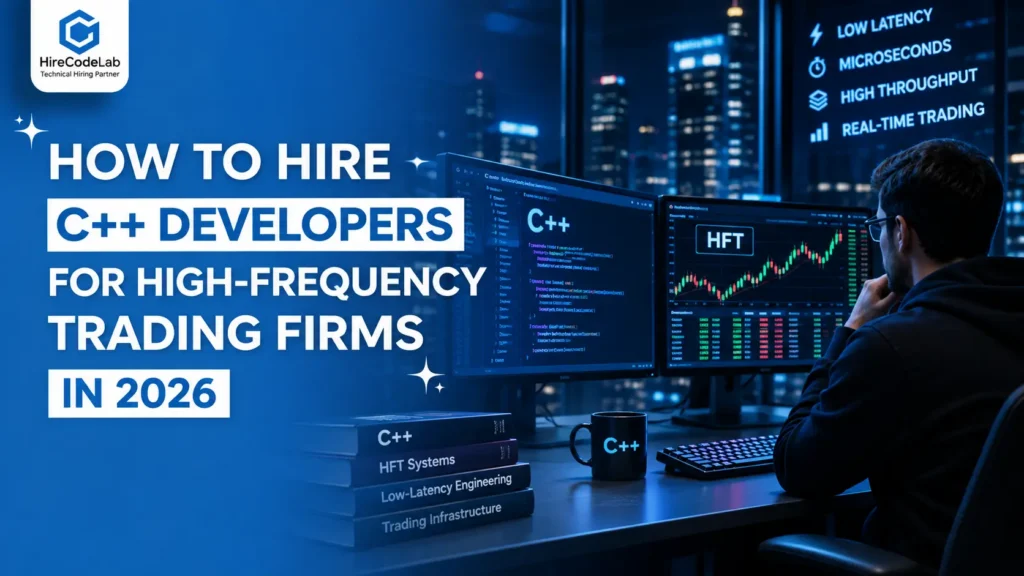
Hiring world-class C++ developers is difficult in any industry – but for high-frequency trading (HFT) firms in 2026, it has become one of the most competitive and expensive talent markets in the world. As trading edges shrink and latency wars intensify, the value of a single microsecond has dramatically increased. The engineers who can unlock those microseconds are rare – and the firms that hire them first win.
This guide breaks down everything HFT hiring managers, CTOs, quant leaders, and talent teams need to know about hiring elite C++ developers, why the market is so challenging today, and how AI-powered recruitment platforms like HuntingCube are transforming this hiring landscape.
Why Hiring C++ Developers for HFT Firms Is Uniquely Challenging in 2026
Unlike typical software roles, HFT C++ hiring operates in a micro-market defined by scarcity, extreme salary expectations, and deep technical specialisation. The wrong hire can set back execution performance by months – or cost millions.
The $600K+ Salary Reality: What HFT Firms Are Paying for Elite C++ Talent
In 2026, top-tier HFT engineers have compensation packages that rival the highest-paid roles in global tech.
Current salary benchmarks:
- Hudson River Trading (HRT): ~$250,000 base salary for experienced C++ engineers
- D.E. Shaw: ~$350,000 base salary for strong low-latency system developers
- Top prop trading firms: Total compensation for elite engineers frequently reaches $500,000–$600,000+
- Specialised PropTech + Algorithmic firms: Some senior candidates report TC above $650,000 when including bonuses and sign-ons
Why these developers command 3–4x typical C++ salaries
Because their code directly affects:
- tick-to-trade latency
- order routing efficiency
- execution slippage
- arbitrage capture
A 50–100 nanosecond improvement in a critical component can translate into millions in additional trading profits. Only a handful of developers have demonstrated that level of optimisation skill.
A talent pool that’s 95% smaller than the general C++ market
Out of millions of global C++ programmers:
- Only ~5% have systems-level programming skills
- Only ~1–2% understand ultra-low latency
- Only ~2,000 globally have 5+ years of direct HFT experience
The result? An extremely tight market where salaries naturally skyrocket.
Why Generic IT Recruitment Firms Fail to Fill HFT C++ Roles
Most IT recruitment firms struggle with HFT mandates simply because hiring a “good C++ developer” is fundamentally different from hiring a “trading-grade C++ engineer.”
Key technical differences
| Standard C++ Roles | HFT C++ Roles |
|---|---|
| Build applications, tools, software features | Build systems where nanoseconds matter |
| Knowledge of C++ and OOP is adequate | Must know lock-free programming, CPU caches, memory barriers |
| Millisecond latency acceptable | Sub-10 microsecond latency required |
| Broad backgrounds acceptable | Only low-latency & systems-tech candidates fit |
Common mistakes non-specialised recruiters make
- Confusing HPC experience with exchange-level low latency
- Sending developers who only worked on backend APIs
- Overlooking required knowledge of NUMA architecture, kernel bypass networking, or CPU pinning
- Not understanding market data, feed handlers, or order-routing systems
- Assuming “FAANG engineers” automatically qualify (they often don’t)
Why AI Recruitment Platforms Are Outperforming Traditional Recruiters
Modern AI recruitment platforms can now:
- scan millions of profiles for micro-skills (“lock-free queues”, “RDMA”, “branch prediction”)
- auto-assess code efficiency using AI-powered tests
- evaluate real-time performance of candidate submissions
- map candidate backgrounds to trading-specific requirements with 90%+ accuracy
AI systems are not replacing recruiters – they’re supercharging them, especially in niche markets like HFT.
The HFT C++ Developer Skill Gap: What Most Hiring Managers Don’t Know
Even senior technical hiring teams often underestimate the depth of specialisation needed in HFT engineering.
Critical HFT-specific skills include:
- Lock-free programming: atomics, ABA avoidance, memory ordering
- 12 ultra-low latency optimisation techniques, including:
- kernel bypass
- busy-polling
- CPU core pinning
- hugepages
- instruction-level optimisation
- Cache warming & branch prediction
- SIMD vectorisation for performance-critical loops
- Microbenchmarking, perf counters, flame graphs
- Choosing between FPGA acceleration vs. pure C++ execution paths
The 2026 Hiring Landscape: New Trends in HFT Recruitment
The global hiring market for HFT engineers has changed radically in just 2–3 years.
1. Remote HFT engineering is now accepted
Advances in:
- remote low-latency debugging tools
- exchange simulators
- containerised trading environments
…have made hybrid hiring viable for the first time.
2. AI-driven trading increases engineering demand
AI-generated strategies require even faster execution engines, pushing HFT firms to scale their C++ teams.
3. A shrinking, ageing talent pool
Only ~2,000 C++ engineers globally meet the HFT experience threshold. Many are in their late 30s–40s, which means the pipeline is not replenishing fast enough.
4. AI-powered recruitment platforms expanding into trading tech
To meet rising demand, AI-powered recruitment platforms can support specialised hiring across:
- low-latency engineering
- trading infrastructure
- quant systems
- exchange connectivity
This specialised focus is now essential to compete for top talent.
Should You Hire Directly or Use an AI-Powered Recruitment Platform?
HFT firms today face a strategic choice: build an internal recruitment engine, use an AI-powered recruitment platform, or combine recruitment technology with specialised human expertise. Each model has different costs, risks, and outcomes.
Building an In-House HFT C++ Recruiting Team: Pros, Cons, and Real Costs
Pros
- Full control over hiring
- Ability to develop long-term talent pipelines
- Deep internal understanding of your tech stack
Cons
- Very high cost to train recruiters in HFT-specific skills
- Slow time-to-hire (industry benchmark: 3–6 months)
- Lower hit rate: Only 1 in 4 hires succeed in HFT roles
Real cost breakdown
- Recruiting manager salary: $80,000–$120,000 annually
- Cost of assessments, interview platforms, travel, tools: $10,000–$20,000 per year
- Opportunity cost:
- every month a role stays unfilled = $50,000–$100,000 in lost trading alpha
Bottom line
Internal hiring works only if you have consistent, high-volume C++ hiring needs and a talent team already educated in low-latency engineering.
Why AI-Powered Recruitment Platforms Specialise in Trading Tech
AI-powered recruitment platforms like HuntingCube offer advantages that general recruitment approaches can’t match.
Advantages
- AI-powered discovery and matching of relevant HFT developers
- AI-assisted candidate ranking based on specialised technical requirements
- Human recruitment expertise for technical and contextual validation
- Speed: relevant candidates can be identified faster than through traditional sourcing
- Higher match quality through a better understanding of low-latency roles
Cost
- The cost depends on the hiring model, role seniority, and recruitment requirements.
When this is worth it
- Senior roles ($200k+ base)
- Urgent hires
- Niche positions requiring immediate impact
AI Recruitment Platforms: Are They Better Than Traditional Recruiters for HFT?
AI recruitment platforms are not replacing human recruiters, but for HFT engineering roles, they have introduced massive efficiency.
How AI improves hiring
- Automatically screens for low-latency skills
- Runs code quality benchmarks on candidate submissions
- Classifies candidates by technique (SIMD, RDMA, kernel tuning)
- Cuts screening time by 50%
Accuracy
AI can identify lock-free programming experience with ~94% accuracy, something many human recruiters miss.
Cost advantage
AI-powered recruitment platforms can reduce manual sourcing and screening effort compared with traditional recruitment approaches.
Best model: Hybrid hiring
Many top firms now use:
- AI tools for initial filtering
- Specialised human recruiters for relationship-based closing
This yields faster hires and higher-quality pipelines.
Comparative Analysis: In-House vs Recruitment Firms vs AI Platforms
| Approach | Time to Hire | Cost | Success Rate | Best For |
|---|---|---|---|---|
| In-House Recruiting | 3–6 months | Medium | Low–Medium | Large firms with recurring needs |
| IT Recruitment Firms | 2–4 weeks | High | High | Senior & niche HFT roles |
| AI Recruitment Platforms | 1–3 weeks | Low | Medium–High | Fast screening, large pipelines |
The Complete Hiring Checklist for C++ Developers at HFT Firms
A structure-driven hiring process dramatically increases the chance of finding the right engineer.
Defining Your Ideal Candidate Profile for HFT
Essential hard skills
- C++17/C++20 mastery
- Low-latency performance tuning
- Network programming
- Linux/Unix systems programming
- Multi-threading and lock-free algorithms
Domain knowledge
- Market data feeds (ITCH, OUCH, FIX)
- Order management systems
- Position risk and trade lifecycles
Nice-to-have skills
- FPGA development
- Python for strategy research
- Knowledge of specific exchange protocols
Experience level matrix
Junior Engineer (2–3 years):
- Strong C++ foundations
- Some exposure to performance engineering
Senior Engineer (5+ years):
- Demonstrated low-latency results
- Independent ownership of critical modules
Staff/Principal (10+ years):
- Architecture-level optimisation
- Ability to improve firm-wide latency benchmark
Compensation structure
- Base salary (varies from $180k–$350k)
- Bonus (can exceed 100% of base)
- Equity/Profit sharing
- Signing bonuses for top-tier candidates
Where to Source Top HFT C++ Developer Talent
1. GitHub
Look for:
- contributors to low-latency libraries
- maintainers of modern C++ frameworks
2. Stack Overflow
Identify high-reputation contributors in:
- C++ performance
- CPU architecture
- systems programming
3. LinkedIn
Use advanced filters for:
- “low latency”
- “market data engineering”
- “HFT C++ developer”
4. Specialised communities
- r/QuantFinance
- C++ Alliance Slack
- Thalesians
- QuantNet
5. Professional networks
- CppCon
- QCon
- Trading Technologies meetups
- QSpark
6. Referrals
Over 60% of HFT hires come from internal referrals – still the best source of talent.
Assessing HFT C++ Candidates: Beyond Generic Coding Tests
Generic coding tests don’t work for HFT.
What to test instead:
- Lock-free queue implementation (30-minute challenge)
- Low-latency optimisation (rewrite slow code to run 10x faster)
- Debug a real HFT code snippet
- Design an API for high-throughput market data
- Domain quiz with questions like:
- acceptable latency targets
- exchange message types
- throughput constraints
Platforms that support HFT-style tests
- CodinGame
- InterviewBit
- CodeChef
Interview Structure for HFT C++ Roles (4-Round Process)
Round 1 — Technical Screen (30 min)
Data structures, C++ memory model, multithreading basics
Round 2 — Deep Technical Interview (90 min)
Low-latency code optimisation, CPU-level reasoning
Round 3 — Domain Interview (60 min)
Meet a quant, trader, or senior engineer
Round 4 — System Design (120 min)
Example exercises:
- design a feed handler
- design an order router
Final Step:
Offer negotiation + culture fit + background checks
Red Flags That Disqualify Otherwise Strong C++ Candidates
- Weak understanding of lock-free programming
- No Unix/Linux systems programming
- Lack of memory management expertise
- Cannot articulate latency budgets
- Overconfidence without real HFT experience
- Poor pressure-handling in technical discussions
2026 Recruitment Strategy Options & ROI Analysis
Choosing the right recruitment strategy is often more critical than the actual interview process. With compensation remaining aggressive and the number of qualified HFT C++ engineers extremely limited, firms must evaluate their hiring model carefully. In 2026, most trading organisations fall into one of four recruitment approaches, each with different investment levels, timelines, and ROI outcomes.
Option A: Build In-House + AI-Powered Recruitment Platform
Model:
Build an internal recruitment team (1–2 specialised tech recruiters) and use an AI-powered recruitment platform that understands the HFT engineering landscape.
Timeline:
8–12 months to build a fully functional pipeline.
Cost Breakdown (Year 1):
- Internal recruiter salary: $80k–$120k
- Platform and recruitment costs: dependent on hiring requirements
Expected Outcome:
2–4 high-quality HFT C++ hires per year.
Best For:
Growing trading firms (100+ engineers) seeking long-term brand building and internal capability development.
Why firms choose this model:
It balances control with speed. Internal recruiters learn the culture; AI-powered recruitment technology helps surface and rank relevant low-latency talent. This is also where HuntingCube fits naturally, using CubicAI to help companies discover and rank relevant candidates while human recruitment expertise adds technical and contextual judgement.
Option B: Use an AI-Powered Recruitment Platform
Model:
Use an AI-powered recruitment platform such as HuntingCube to identify and match relevant HFT and low-latency engineering talent.
Timeline:
6–12 weeks to hire for most roles.
Cost Per Hire:
Dependent on the platform, role seniority, and recruitment requirements.
Expected Outcome:
- High candidate quality
- Fast candidate discovery
- Reduced internal sourcing burden
Best For:
- Early-stage prop firms
- Organisations with urgent hiring needs
- Firms making one-off senior or principal-level hires
ROI Justification:
If the hired engineer contributes even $500k+ in annual trading alpha, the recruitment investment can pay for itself quickly.
This model works incredibly well for firms that don’t have the time, bandwidth, or internal expertise to run an HFT-specific recruitment process from scratch.
Option C: Hybrid AI Recruitment + Human Expertise Model
Model:
Use AI-powered recruitment technology for automated screening, candidate discovery, coding tests, and skill mapping → then bring in specialised human recruiters to interview, validate, and close candidates.
Timeline:
4–8 weeks.
Cost Per Hire:
Dependent on the AI platform, assessments, and human recruitment support required.
Expected Outcome:
- High speed
- High accuracy
- Access to broader candidate pools
Best For:
- Firms hiring multiple C++ roles at once
- Firms with limited budgets
- Crypto firms scaling rapidly with aggressive engineering needs
2026 Trend:
Hybrid AI + human recruitment models are increasingly being used to improve screening precision while keeping human judgment in the hiring process.
Option D: In-House Recruiting Only
Model:
Build a world-class internal recruiting team capable of sourcing HFT-grade talent independently.
Timeline:
3–6 months per hire.
Cost:
$120k–$160k per year (recruiting team salaries, tools, assessments).
Expected Outcome:
- Strong cultural alignment
- Long-term hiring autonomy
- Deep internal understanding of tech stack
Best For:
Only elite, fully matured trading firms (Citadel, Jane Street, Optiver, Hudson River Trading) with massive hiring volumes and brand pull strong enough to attract passive candidates.
Most small-to-mid-sized firms struggle with this approach due to lack of existing hiring momentum.
Recommendation Matrix: Which Strategy Wins for Your Firm?
| Firm Type | Recommended Strategy |
|---|---|
| Early-stage prop trading firm (10–20 engineers) | Option B (AI-Powered Recruitment Platform) or C (Hybrid AI + Human Expertise) |
| Mid-size hedge fund (50–100 engineers) | Option A (In-house + AI-Powered Recruitment Platform) |
| Large multi-strategy fund (200+ engineers) | Option A + B combined |
| Crypto trading firm scaling aggressively | Option C is ideal |
Subtle Reality:
Most fast-growing firms today can benefit from hybrid models, combining internal talent teams with AI-powered recruitment platforms like HuntingCube to identify and rank relevant low-latency C++ developers while keeping human expertise involved in the hiring process.
Competitive Salary Benchmarks for 2026 HFT C++ Hiring
Compensation for HFT engineers in 2026 remains aggressive. Firms need a clear understanding of market benchmarks to attract elite talent without wasting cycles on unrealistic salary expectations.
Base Salary Benchmarks by Experience Level & Firm Type
By Experience Level
- Junior (2–3 years): $150k–$200k base + 30–50% bonus
- Mid-level (4–6 years): $200k–$300k base + 50–100% bonus
- Senior (7–10 years): $300k–$450k base + 100–200% bonus
- Staff/Principal (10+ years): $450k–$600k+ base + 200–300% bonus
By Firm Type
- Tier-1 prop shops (Citadel, Jane Street, Optiver) pay 20–30% higher than hedge funds or mid-tier firms.
Total Compensation (TC) Reality Check
- Senior HFT C++ Engineer TC Range:
- $500k–$750k per year
- Even higher for tech leads in certain markets.
Top Compensation Levels
Amsterdam-based HFT firms (IMC, Optiver, Flow Traders) often pay:
- $750–$800k TC for senior engineers
- $1M+ for principal-level engineers
Why signing bonuses matter
$50k–$150k signing bonuses are common in highly competitive HFT hiring due to talent wars and aggressive counter-offers.
Equity & Profit Sharing
Senior engineers may receive 0.1–0.5% equity, which can become life-changing during high-return years.
Non-Monetary Factors That Attract Top C++ Talent
Elite engineers don’t choose roles based on salary alone.
They care about:
- Challenging technical problems (this is their #1 motivator)
- Engineering culture and autonomy
- Work-life balance (yes, even in HFT – firms have become competitive here)
- Remote/hybrid flexibility
- Mentorship from industry legends
- Modern tooling and infrastructure
Firms that articulate these non-monetary advantages in job descriptions dramatically improve candidate interest – something HuntingCube can support by helping teams understand and communicate specialised hiring requirements effectively.
Hiring Timeline, Critical Success Factors & FAQ
Realistic Timeline for HFT C++ Developer Hiring
Month 1:
Role definition, JD creation, recruitment platform selection, sourcing begins
Month 2:
Technical screening, coding assessments, interviews
Month 3:
Final interviews, offer negotiation, background checks
Month 4:
Onboarding + performance ramp-up
Industry Benchmark:
Mid-level C++ roles: ~90 days
Staff/Principal engineers: 4–6 months
Top 5 Critical Success Factors
- A clear job description
Must specify HFT-specific expectations (latency targets, market data, lock-free programming). - The right recruitment technology and expertise
AI-powered recruitment platforms and specialised human recruitment expertise can improve the ability to identify, evaluate, and engage niche HFT talent. - Fast decision-making
Top candidates may receive 3–5 offers simultaneously. Slow firms routinely lose talent. - Competitive offer
Must match current market benchmarks – internal bands are irrelevant in HFT hiring. - Strong onboarding experience
Early momentum = long-term retention.
Frequently Asked Questions
How do we identify real HFT expertise vs. buzzwords?
Look for proof of optimisation work: measurable latency improvements, experience with lock-free programming, kernel bypass, NUMA optimisation.
Should we hire from competitors or groom fresh talent?
Senior roles: hire from competitors.
Junior pipelines: consider growing from universities + training.
What if we cannot match the $600k salaries?
Increase bonus pools, profit sharing, or offer unique technical challenges.
How important are specialised recruitment platforms for HFT hiring?
AI-powered recruitment platforms can help identify and rank specialised talent more efficiently, while human expertise remains important for technical validation, relationship-building, and closing candidates.
Can AI recruitment platforms replace human recruiters?
Not fully. AI excels at filtering, matching, and surfacing relevant candidates; humans excel at relationship-building, contextual judgement, and closing candidates.
Common Hiring Mistakes to Avoid
- Treating HFT hiring like typical software engineering
- Underestimating the 95% skill gap
- Slow hiring cycles leading to candidate dropout
- Lowballing offers (HFT engineers know their value)
- Hiring purely on technical skill without evaluating pressure-handling, mindset, and team fit
Conclusion & Next Steps
The Path Forward: Your Hiring Action Plan
Immediate (Week 1):
- Define requirements
- Lock compensation structure
- Align internal stakeholders
Short-Term (Week 2–3):
- Choose recruitment approach
- Use an AI-powered recruitment platform, specialised human recruitment expertise, or a hybrid model
Medium-Term (Month 1–2):
- Launch sourcing
- Conduct structured interviews
- Run domain-specific coding tests
Long-Term (Month 3–4):
- Extend offer
- Onboard quickly
- Integrate into trading pipeline
Key Takeaway
Hiring C++ developers for high-frequency trading firms is a specialised, competitive, and high-stakes process. Whether you build an in-house team, use an AI-powered recruitment platform, adopt AI-driven recruitment, or leverage a hybrid model, the key is understanding the rarity of HFT skills and moving fast with competitive, market-aligned offers.
In 2026, firms that win the C++ talent race win the speed race – and ultimately, the trading race.
This is also where HuntingCube fits into the modern HFT hiring process. Its AI-powered recruitment platform, powered by CubicAI, helps companies discover and rank relevant C++ and HFT talent, while human recruitment expertise adds the technical and contextual judgement needed for specialised hiring.