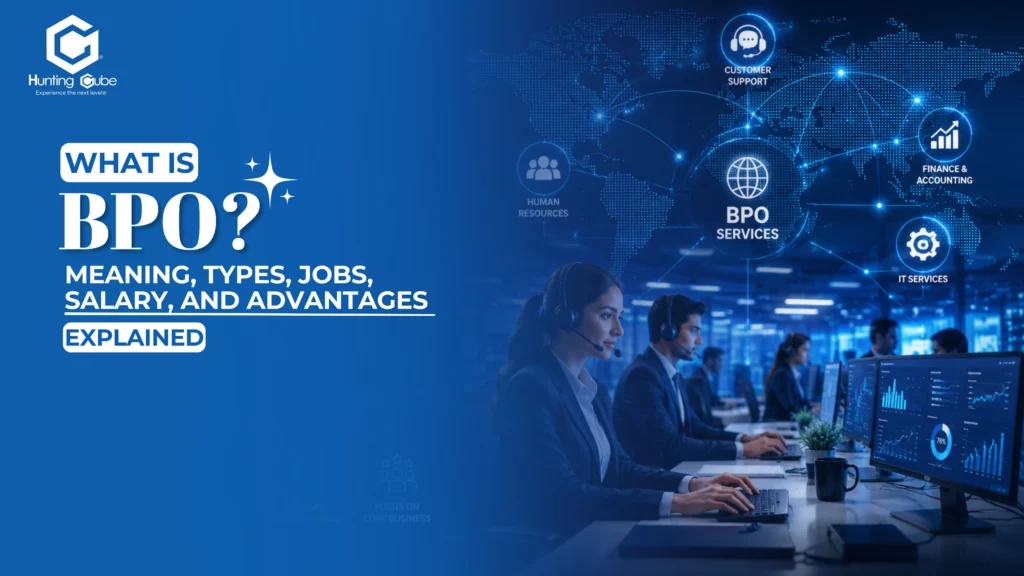
You’ve heard of BPO jobs everywhere but what exactly is BPO, and why do companies rely on it so heavily?
In simple words, BPO full form is Business Process Outsourcing. It means a company gives certain business tasks to an outside service provider instead of doing everything in-house. So, if you’ve ever wondered what is BPO, how it works, what BPO jobs involve, or whether BPO is a good career, this guide explains everything clearly — meaning, types, services, salary, advantages, disadvantages, and the BPO industry in India.
What Is BPO? Definition & Meaning
BPO stands for Business Process Outsourcing, where companies outsource specific business operations to external service providers.
The BPO meaning is quite simple. A company may not want to manage every task internally. Some work is important, but not always central to the company’s main business. So, it hires another company to handle that process. For example, a software company may build products in-house but outsource customer support to a BPO company. A bank may outsource data entry, document verification, or call center operations.
So when someone asks, what is BPO in simple words, think of it like this: BPO is when a company says, “This work matters, but it is not our core strength. Let experts handle it better, faster, and often at a lower cost.” That is the basic idea behind business process outsourcing.
What Is the Full Form of BPO?
The BPO full form is Business Process Outsourcing.
It means outsourcing a business process to a third-party company. These processes can include customer service, HR support, payroll, data entry, technical support, finance, and more. BPO is not limited to call centers, though many people still think of it that way. Call centers are only one part of the larger BPO industry.
How Does BPO Work?
BPO works through a simple outsourcing process. First, a company identifies tasks that are necessary but not its main business focus. These may include customer support, payroll, finance operations, data processing, or back-office work.
Then, the company chooses an external BPO service provider. This vendor has trained employees, systems, tools, and processes to manage that work. Once the agreement is signed, the vendor starts handling the assigned operations.
For example, imagine an e-commerce company receiving thousands of customer queries every day. Instead of hiring and training a large internal support team, it may outsource customer service to a BPO company. The BPO team answers calls, responds to chats, manages complaints, and updates customers.
The company gets to focus on products, logistics, and growth. The BPO provider handles the support function. That’s how BPO works in practice.
Types of BPO With Examples
BPO is not just call centers. It has different types depending on the kind of work and where the service provider is located.
Back Office BPO
Back office BPO includes internal business functions that customers usually don’t see directly. Examples include:
- Data entry
- Payroll processing
- HR administration
- Finance and accounting
- Document verification
These tasks are important for the business to run smoothly, but they don’t involve direct customer interaction.
Front Office BPO
Front office BPO involves customer-facing work. Examples include:
- Customer support
- Sales calls
- Technical support
- Helpdesk services
- Chat and email support
This is the type most people associate with BPO jobs, especially call center roles.
Offshore BPO
Offshore BPO happens when a company outsources work to a service provider in another country. For example, a US company outsourcing customer support to India is using offshore BPO. This model is popular because it can reduce costs and provide access to skilled talent.
Nearshore BPO
Nearshore BPO means outsourcing to a nearby country. For example, a company in the US outsourcing work to Mexico. The benefit is similar time zones, easier coordination, and cultural familiarity.
Onshore BPO
Onshore BPO means outsourcing within the same country. For example, an Indian company outsourcing payroll processing to another Indian BPO provider. It may cost more than offshore BPO, but communication and compliance can be easier.
Common BPO Services: Real Examples
BPO services cover many areas of business. It is not one single job or one single department. Common examples of BPO services include:
| BPO Service | What It Includes |
|---|---|
| Customer Support | Calls, chats, emails, complaint handling |
| Technical Support | Troubleshooting, software help, device support |
| Payroll Processing | Salary calculation, tax deductions, payslips |
| HR Services | Recruitment support, onboarding, employee records |
| Data Entry | Updating databases, forms, documents |
| Finance & Accounting | Invoice processing, bookkeeping, reporting |
Many BPO companies also fall under ITES, or IT-enabled services, because they use technology to deliver business support. So, when people ask what does a BPO company do, the answer depends on the client’s need. Some handle calls. Some handle payroll. Some manage complex backend operations.
Advantages of BPO
The advantages of BPO are one big reason companies continue to use outsourcing.
1. Cost Savings
BPO helps companies reduce operational costs. Instead of hiring, training, and managing large internal teams, businesses can work with external experts.
2. Focus on Core Business
A company can focus on what it does best. For example, a product company can focus on building better products while a BPO partner handles customer queries.
3. Access to Expertise
BPO providers already have trained teams, systems, and industry knowledge. This helps businesses get better execution without building everything from scratch.
4. Scalability
If customer demand increases, a BPO team can scale faster. This is useful during festive seasons, product launches, or sudden growth phases.
5. Faster Operations
A good BPO partner can improve turnaround time. Tasks like data entry, verification, and support can move faster when handled by dedicated teams.
In short, BPO helps convert some fixed costs into flexible costs. That gives businesses more room to grow.
Disadvantages of BPO
Like every business model, BPO also has challenges.
1. Data Security Risks
When sensitive customer or company data is shared with an outside vendor, security becomes a serious concern.
2. Vendor Dependency
If a company depends too much on one BPO provider, any service failure can affect business operations.
3. Quality Issues
Not every BPO provider delivers the same quality. Poor training or weak processes can lead to customer dissatisfaction.
4. Communication Gaps
Different time zones, accents, work cultures, or unclear instructions can create communication problems.
5. Hidden Costs
Sometimes outsourcing looks cheaper in the beginning, but extra costs may appear later through training, software, contract changes, or quality control.
So yes, BPO offers many benefits. But companies must choose the right partner and set clear expectations.
BPO vs KPO vs LPO: Key Differences
BPO, KPO, and LPO are all outsourcing models, but they are not the same.
| Type | Meaning | Work Type |
|---|---|---|
| BPO | Business Process Outsourcing | Repetitive or process-based tasks |
| KPO | Knowledge Process Outsourcing | Research, analytics, expert knowledge work |
| LPO | Legal Process Outsourcing | Legal documentation, contracts, legal research |
The main difference between BPO and KPO is the level of expertise required. BPO usually focuses on process execution. KPO focuses on knowledge-heavy work like market research, financial analysis, or business intelligence. LPO is specifically related to legal services. So, BPO is broader and often more process-driven. KPO and LPO are more specialised.
What Is a BPO Job?
A BPO job is a role where an employee works for a company that handles outsourced business processes for clients. Common BPO jobs include:
- Customer support executive
- Technical support associate
- Voice process executive
- Non-voice process executive
- Data entry operator
- Backend operations executive
- Team leader
- Quality analyst
In a voice process role, employees usually speak to customers through phone calls. In a non-voice process, they may handle emails, chats, data entry, or backend tasks.
So, what is BPO job really? It is a job where you help another company run a specific process smoothly.
Skills Required for BPO Jobs
BPO jobs require more than just speaking on calls. Some important skills for BPO jobs include:
| Skill | Why It Matters |
|---|---|
| Communication Skills | Helps in handling customers clearly |
| Problem-Solving | Useful for resolving issues quickly |
| Customer Handling | Important for support and service roles |
| Technical Basics | Needed for software, tools, and systems |
| Time Management | Helps in meeting targets and deadlines |
| Patience | Very important in customer-facing roles |
Strong BPO communication skills are especially important. You need to listen properly, understand the issue, and respond without creating more confusion. For freshers, BPO can be a good place to build confidence, discipline, and workplace communication.
Salary in BPO Industry in India
BPO salary in India depends on role, company, location, shift, experience, and skill level. Entry-level BPO jobs may start with modest salaries, especially for freshers. However, employees can grow into team leader, quality analyst, trainer, operations manager, or client management roles over time.
| Experience Level | Approx Salary Range in India |
|---|---|
| Fresher / Entry-Level | ₹1.8 LPA – ₹3.5 LPA |
| 1–3 Years Experience | ₹3 LPA – ₹5 LPA |
| Team Leader / Senior Executive | ₹4.5 LPA – ₹8 LPA |
| Operations Manager | ₹8 LPA – ₹15 LPA+ |
International voice processes, night shifts, and technical support roles may offer higher pay compared to basic domestic processes. The salary may not look huge at the beginning, but the growth can be decent if you build strong skills and move into leadership.
Is BPO a Good Career?
Yes, BPO can be a good career option, especially for freshers.
It helps people build communication skills, customer handling ability, confidence, and professional discipline. Many people start in BPO roles and later move into operations, training, HR, quality, sales, or management roles. But it is also important to be realistic.
Some BPO jobs can feel repetitive. Shift timings may be challenging. Customer-facing roles can be stressful. Still, for someone starting out, BPO can be a solid entry point into the corporate world.
BPO Industry in India
The BPO industry in India is one of the strongest parts of the country’s services sector. India became a major outsourcing hub because of its English-speaking workforce, cost advantage, technology talent, and large young population. Many global companies outsource customer support, IT-enabled services, finance, and backend operations to Indian BPO companies.
Cities like Bengaluru, Gurugram, Pune, Hyderabad, Chennai, Mumbai, and Noida have strong BPO presence. The industry also creates jobs for freshers, graduates, language experts, tech support professionals, and operations leaders. That is why BPO in India is not just about employment — it is a major part of the country’s business services ecosystem.
Conclusion
So, what is BPO?
BPO, or Business Process Outsourcing, is when a company gives specific business tasks to an external service provider. It helps businesses save costs, improve efficiency, and focus on their core work. But BPO is not just call centers anymore. It includes customer support, HR, payroll, finance, technical support, data processing, and much more.
For job seekers, BPO can also be a practical career starting point. It teaches communication, discipline, problem-solving, and customer management — skills that matter almost everywhere.